
01
Name the construction before comparing it
“Cotton jersey” combines a fiber name with a fabric description. “Interlock” names a construction. A cotton interlock is therefore possible; cotton and interlock are not competing fiber options. Ask for both the composition and the precise knitted structure on the swatch label.
CottonWorks defines plain jersey through one set of knitting needles and a different appearance on each side.[1] Its interlock entry describes a double-knit construction formed using two sets of needles.[2] Neither definition specifies a finished weight or a garment quality level.
Read the construction family
One needle set
Plain single jerseyTwo needle sets
Rib · Interlock · Other double-knit constructionsCottonWorks lists rib, interlock, Ponte di Roma and double-knit jacquards among double knits.[3] Do not replace the broad phrase “double jersey” with “interlock” without supplier confirmation. This guide uses basic interlock as the main comparison candidate; its observations cannot be assigned to every double knit.
If a supplier cannot identify the construction immediately, request a technical confirmation tied to the fabric code. Keep “structure unconfirmed” visible in the brief instead of quietly treating a sales description as a verified specification.
02
Turn the swatch over
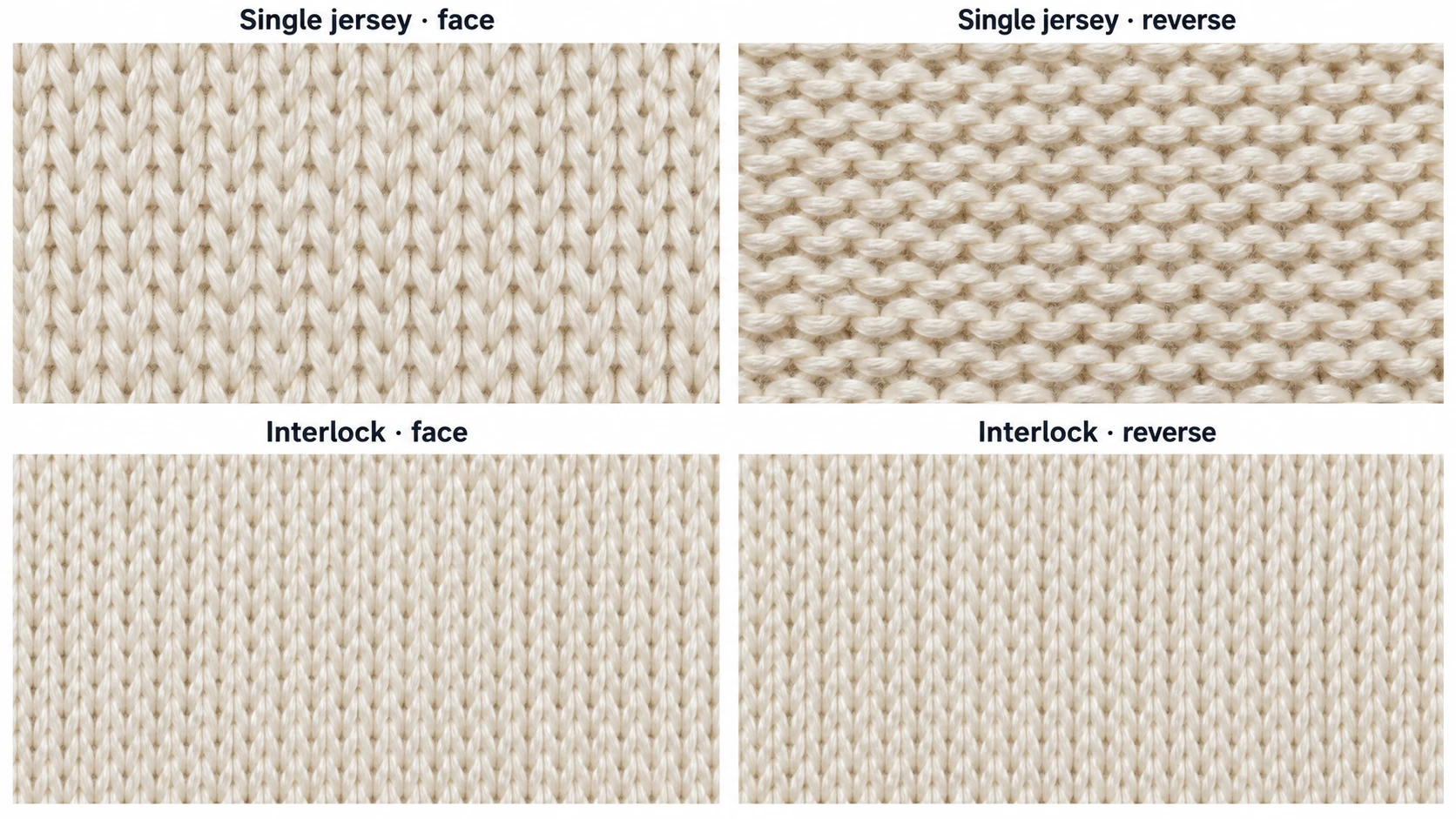
On plain single jersey, look for V-like stitch columns on the technical face and curved loop features on the reverse. Basic interlock presents a similar appearance on both sides.[1][3] “Technical face” describes the structure; a designer may still choose the reverse as the visible garment surface.
Label the intended outside, length direction and sample ID before sending photographs. Capture both surfaces under the same light, plus one wider view of the cut edges. Brushing, prints or finishes can obscure the clues, so photographs should support the mill’s identification rather than replace it.
A material can have a plain-looking face yet use a more complex construction. If you are developing a garment with an exposed inside, ask which surface will remain visible at the neckline, turned cuff or opening. Do not infer identical color or finish on both sides from the word “double.”
03
Treat matched GSM as one control, not a complete experiment
A matching label removes only the differences it actually describes. CottonWorks’ fabric-analysis guidance treats yarn size and type, weight, stitch counts and stitch length as distinct parameters.[4] Two shortlisted fabrics can still differ in several of these fields, as well as in finishing and the state in which they were measured.
| Field | Candidate A | Candidate B |
|---|---|---|
| Composition requested | 100% cotton | 100% cotton |
| Construction requested | Plain single jersey | Basic interlock |
| Nominal target for comparison | 200 g/m² | 200 g/m² |
| Actual finished weight / condition | To be measured and recorded | To be measured and recorded |
| Yarn, construction details and finish | Supplier to disclose | Supplier to disclose |
| Coverage, drape and care results | Not yet observed | Not yet observed |
The 200 g/m² value is a fictional briefing example, not a recommended T-shirt weight or a test result. No performance ranking follows from the table.
Match the intended shade, finish and comparison condition as closely as practical. If one candidate contains elastane or has a different yarn or finish, retain that information. You can still choose between the two commercial fabrics, but you cannot attribute every difference to knit structure alone.
Use the fabric GSM guide for weight fundamentals. Here, the decision is what the construction contributes beyond that single field. Do not demand identical knitting settings across different structures merely to create an appearance of experimental control.
04
Compare the properties the garment will expose
Begin with the intended product: an easy everyday tee, a close-fitting top or a garment with a more substantial silhouette. Then select observations that answer that brief. The table below separates a useful structural clue from a result that needs evidence.
| Question | Useful starting point | What to verify on the actual candidates |
|---|---|---|
| Face and reverse | Plain single jersey differs across its two sides; basic interlock looks similar on both | Chosen outside surface, shade and finish |
| Cut-edge curl | Plain single jersey can curl; balanced basic interlock generally lies flatter | Unrestrained cut edges in the same relaxed condition |
| Coverage / show-through | The construction name does not guarantee opacity | Actual color, intended fit/extension and consistent viewing setup |
| Stretch and return | Do not rank all double knits together | Length and width response; what remains after release |
| Drape and body | Weight alone does not describe the silhouette | Same-size panels, same direction/support, then a garment trial |
| After care | A flatter raw edge does not establish low shrinkage | Recorded length/width changes and garment appearance |
The surface and curl clues are consistent with CottonWorks’ discussion of basic structures.[3] The remaining rows are a development checklist, not published head-to-head results. A rib and an interlock should not share a stretch rating simply because both are double knits.
For a familiar casual T-shirt, single jersey is a sensible candidate to sample. For a brief emphasizing similar-looking surfaces and a less curling cut edge, include basic interlock in the shortlist. Choose the actual material that satisfies the brief, rather than declaring one category universally “premium.”
05
Set up a fair visual comparison
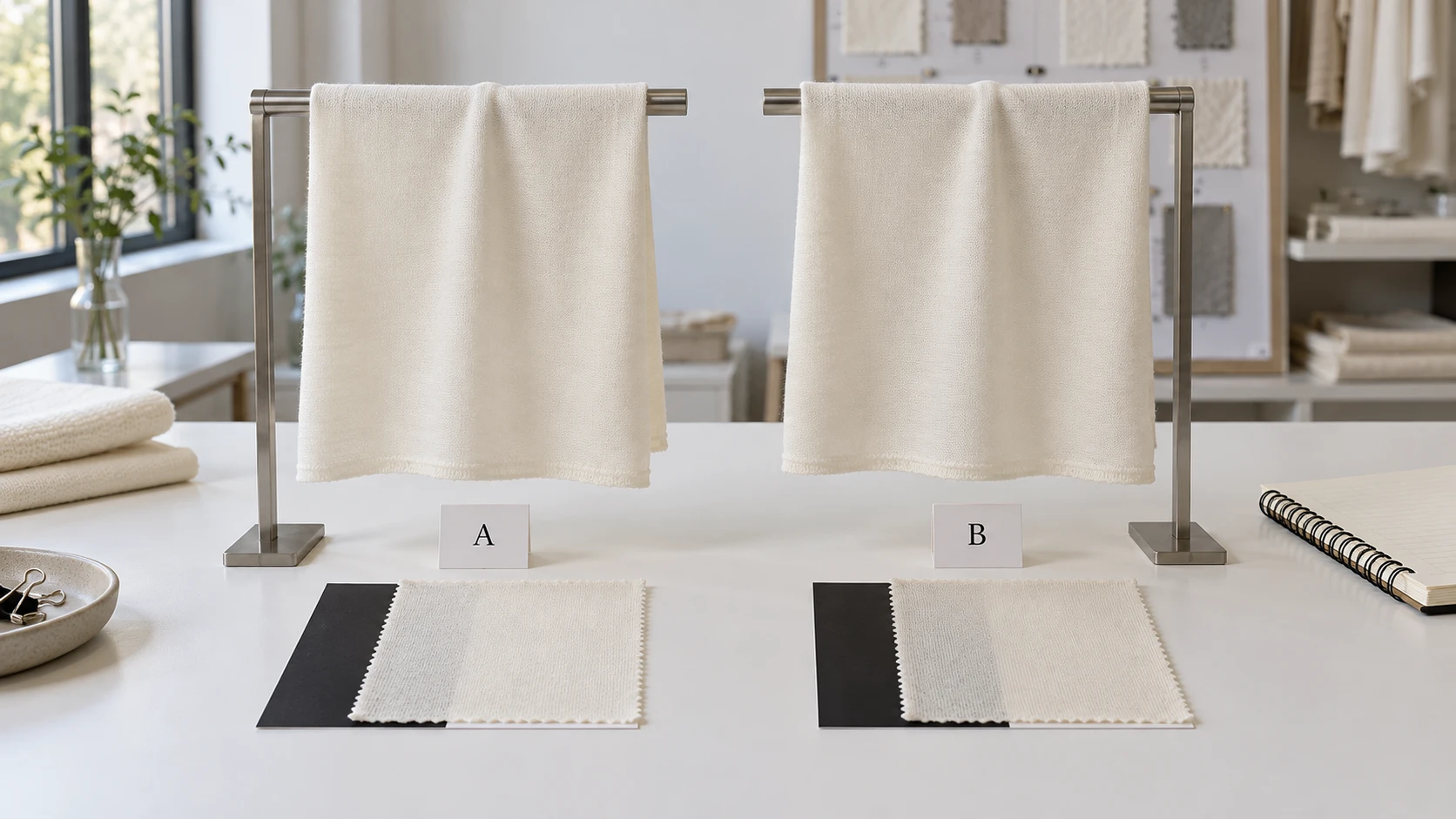
Keep the comparison conditions visible
- Identify and prepareFabric codes, intended face, direction, dimensions and sample condition
- Hold the setup steadySame light, background, support and viewing distance
- Observe the use conditionRelaxed first; record any separate extension or care treatment
- Save the evidenceMatched photos, observations, unresolved variables and next action
For show-through screening, place equal-size, single-layer pieces over the same contrasting background. Use the intended garment color. Compare the relaxed state separately from any agreed extension that represents the fit; do not stretch one swatch while leaving the other loose. Keep camera exposure consistent if photographs will be compared.
For drape, align the same fabric direction and use the same panel size and support. Record how the panels hang without pulling them into a preferred shape. This simple observation helps narrow candidates; it is not an instrumental drape coefficient or a universal comfort test.
For edge handling, examine unrestrained cut edges separately from a hemmed sample. A sewn or pressed edge is a different condition. Note whether any temporary handling treatment was used, so a photograph of a flattened piece is not mistaken for its relaxed behavior.
06
Separate movement from behavior after washing
Stretch during movement and the dimension remaining after release answer different questions. ASTM D2594 distinguishes stretch under a known load from growth following extension and release.[5] Record direction, preparation, loading or extension, hold and recovery conditions before comparing numbers. A hand pull is only a screening observation.
The same standard states that it is not recommended for commercial-shipment acceptance testing because between-laboratory precision is poor.[5] Ask a qualified laboratory to agree a suitable method and its limitations for the product. Do not turn an informal swatch comparison into a standardized test claim.
Keep laundering results separate. AATCC TM135 addresses length and width changes of fabrics after specified home-laundering procedures.[6] Define the care and drying route, repetitions and assessment condition, and record each direction separately. A fabric test result does not automatically approve the fit and seams of the assembled garment.
Where washing changes the appearance, retain before/after references for both candidates. Record any edge distortion, surface change or altered hang that matters to the style. This article does not assign a passing shrinkage percentage or predict which fabric will win.
07
Recheck the pattern and seams when the fabric changes
Do not treat a change from single jersey to interlock as a purchase-order substitution only. Sew the nominated material into the intended style and review the silhouette, opening dimensions, seam crossings, neckline and hem. Use the actual trims and decoration where these affect the result.
| Observation | Next step |
|---|---|
| The top hangs differently from the reference | Review the intended silhouette and pattern with the new material |
| An opening feels restricted or remains enlarged | Separate garment dimensions, fabric response and seam limitations |
| A crossing looks bulky or the hem waves | Review the full assembly with the sewing technician |
| Decoration changes the surface or hang | Repeat the relevant strike-off or sew-out on the nominated fabric |
| The washed sample no longer matches the brief | Record the care history and revise before approving the material/style combination |
These are investigation directions, not diagnoses from the fabric name. Change one variable at a time where practical, and record combined changes when that is not possible. Retain the old and revised sample IDs so the team can see what the new approval replaces.
The T-shirt fabric sourcing guide covers the wider material brief and commercial comparison. Add the exact knit structure and this comparison record to make the next sampling request more specific.
08
Request swatches you can compare
Use the editable record to describe the intended garment, enter Candidate A and Candidate B, and document shared observation conditions. It keeps unanswered fields visible and separates actual findings from proposed tests. Attach the referenced photographs separately; the record stores text.
A clearer swatch request
Please propose a plain single-jersey candidate and a basic-interlock candidate for the attached garment brief. Identify composition, finished weight and condition, yarn details, exact construction, finish and shade. Flag differences that prevent a close comparison. Supply enough of each nominated fabric for matched observations and a garment trial; confirm the required quantity with the development team.
When discussing fabric options with Yuchen, include the reference silhouette and the property you are trying to improve. “Less show-through at the intended fit” gives the team a clearer task than “upgrade to double jersey.”
Single jersey and interlock comparison record
Fill in the record, export it to continue later, or print your completed brief. No account is required.
Open the editable worksheet ↗Download blank text brief09
Questions about jersey and interlock
Is double jersey always interlock?
Do not assume so. Ask the supplier to identify the exact construction and link it to the fabric code. Interlock is one double-knit structure; the broader category also contains other constructions.
Does interlock have to contain elastane?
No. The name identifies construction rather than composition. Record fiber percentages separately and verify the actual movement and return behavior.
Will the same GSM give the same opacity?
It does not establish that result. Compare the actual candidates in the intended color and fit condition under consistent viewing conditions.
Can a photo prove which fabric I am buying?
A face/reverse photo provides useful clues, but keep the mill specification and a traceable physical swatch. Surface treatments can obscure structural features.
Should the worksheet choose the winner automatically?
No. Prioritize requirements for the garment and record the evidence. A candidate with missing care or fit information remains unresolved rather than receiving a default passing score.
Sources & further reading
Sources checked 17 October 2026. Definitions explain the construction; public test-method scopes explain applicability. They do not supply a performance ranking or product acceptance limit.
- CottonWorks — JerseyDefines plain jersey, its single needle set and different face/reverse appearance.
- CottonWorks — InterlockDefines interlock as a double knit and describes its two needle sets. It is a construction, not a fiber composition.
- CottonWorks — Single & Double KnitsExplains double-knit families, basic rib and interlock, surface appearance and curling tendencies. General descriptions are not matched-weight performance measurements.
- CottonWorks — Fabric Analysis: Knits and WovensIdentifies yarn size/type, fabric weight, stitch counts and stitch length as separate analysis parameters. This is an educational course description, not experimental data.
- ASTM D2594/D2594M-21 — Stretch Properties of Knitted Fabrics Having Low PowerPublic scope distinguishes stretch and growth. The standard warns against commercial-shipment acceptance testing because between-laboratory precision is poor; discuss suitability with the laboratory.
- AATCC TM135-2025 — Dimensional Changes of Fabrics after Home LaunderingPublic scope covers length and width changes in fabrics suitable for home laundering. It supplies no universal passing limit for a T-shirt fabric.