
Material decisions, made clearer
Fabric GSM.
The weight.
The whole feel.
A fabric guide for T shirts and hoodies.
Start with weight. Then look at the knit, the composition and the finish. The right fabric comes from how they work together.
Explore the guideA number helps you brief it. A sample helps you choose it.
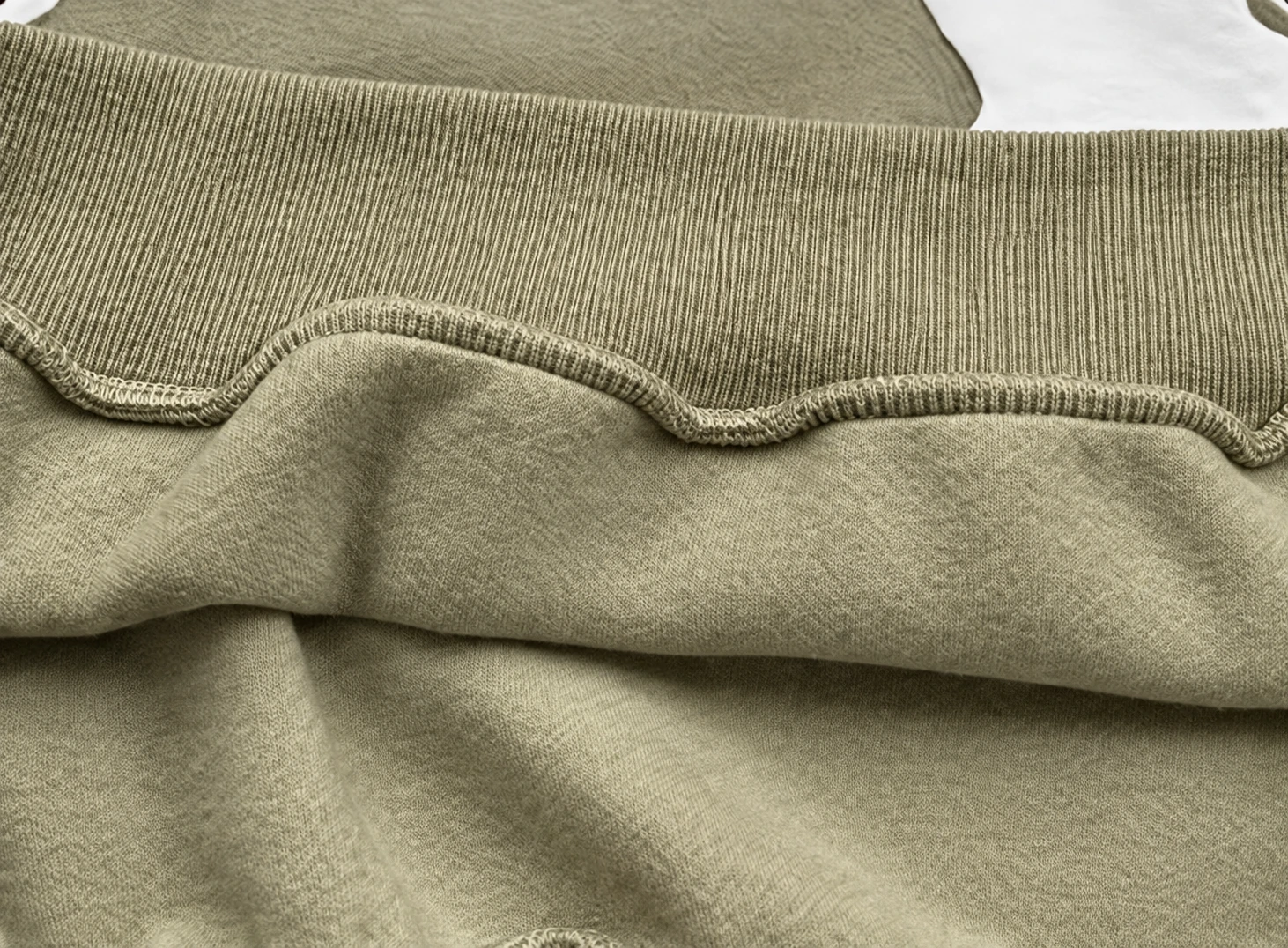
Weight / area
Same area.
Different weight.
GSM means grams per square metre: the mass of a known area of fabric. It is not the weight of a finished garment. [1]
Compare weight alongside construction and finish. More GSM alone does not establish softness, warmth, durability or quality.
Illustration of area, not a life-size swatch.
Try an illustrative weight
g/m²
1 m² of this example fabric weighs 240 g.
These are calculation examples, not recommended ranges or Yuchen stock specifications.
Weigh a measured area under agreed test conditions. ASTM D3776/D3776M describes methods for measuring mass per unit area; a small-swatch result does not necessarily represent the whole lot. Agree the method and tolerance for your order. [1]
Construction / texture
Turn it over.
Read the knit.
For these T-shirt and sweatshirt fabrics, “knit” describes the structure. Jersey, French terry and sweatshirt fleece can look or feel different even at a similar GSM. [2]
Single jersey
A plain knit with visibly different front and back surfaces. A common starting point for T shirts.
- Look for
- The face, reverse and stretch response.
- Confirm
- Opacity and shape in the finished sample.
French terry
Unnapped float loops on the reverse create the familiar loop-back surface used in sweatshirts and layering pieces.
- Look for
- The size and feel of the back loops.
- Confirm
- Drape and comfort in your intended layer.
Sweatshirt fleece
Brushing or napping the back creates a raised, fleecy surface. Review the inside as carefully as the face.
- Look for
- Loft and the finished inner surface.
- Confirm
- Feel after washing and suitability for use.
Drawings explain surface differences; they are not technical stitch diagrams or photographs of available fabrics. Construction notes: CottonWorks — Single & Double Knits.
Composition / hand / drape
Brief the feeling.
Then the fabric.
Hand is what you feel when you touch a fabric. Drape is how it falls. Review both with the yarn, construction and final finish in mind. Finished sample yardage matters. [3]
Same label.
More questions.
“Cotton” or “cotton blend” is only part of the specification. Ask for exact fiber percentages and the intended finish; inspect the face and back.
For a stretch blend, ask what the finished fabric does after stretching. For any blend, confirm its actual performance with a sample.
Use the sample checklistIllustrative design briefs, subject to development review.
Soft hand. Easy fall.
Discuss jersey and a soft finish. Send a reference for the drape you want; check opacity and the silhouette on body.
Ask about custom T shirtsDry hand. Defined shape.
Discuss the fabric’s body and finish alongside weight. Approve the shoulder line, hem and shape after laundering.
Ask about custom T shirtsChoose the inside, too.
Compare loop-back French terry with brushed sweatshirt fleece. Confirm the desired warmth, hood shape and next-to-skin feel in a sample.
Ask about custom hoodiesFrom screen to sample
The final decision
is physical.
A photograph can show texture. It cannot prove weight, fiber content, hand or wash performance. Use this checklist to prepare a fabric discussion.

Before you approve a fabric
Tick the points you have prepared. Saved only while this page stays open.
A few useful distinctions.
Does higher GSM mean better quality?
No. GSM describes mass per unit area. Judge the finished material against its purpose and the agreed requirements for construction, appearance, feel and performance.
Is a 240 GSM T shirt a 240 gram garment?
No. At 240 GSM, one square metre of fabric weighs 240 grams. The finished garment weight also depends on the amount of fabric, its size and construction, trims and decoration. The number here is an example, not a product specification.
Can I choose a fabric from a photo?
A photo is a useful starting reference. Confirm fiber content and target weight separately, then review a finished physical swatch and garment sample for feel, drape and the intended use.
Are the weights in this guide available to order?
The calculator shows mathematical examples. It is not an availability list. Send your desired fabric direction with your garment brief so suitable options can be reviewed for the project.
Your next material decision
Bring the reference.
Define the feel.
Share your garment type, target weight if known, composition preference and the finish you want to achieve. Email links open your email app; nothing is sent automatically.
Technical references
General textile education, separate from Yuchen product specifications. Reviewed 21 September 2026.
- ASTM D3776/D3776M-20(2025)Mass per unit area, test options and the limits of small-swatch results.
- CottonWorks: Single & Double KnitsJersey, French terry and sweatshirt fleece structures.
- CottonWorks: Designing Knit TextilesEnd use, yarn, construction and finished sample evaluation.