
01
Inspect four views of the same sample
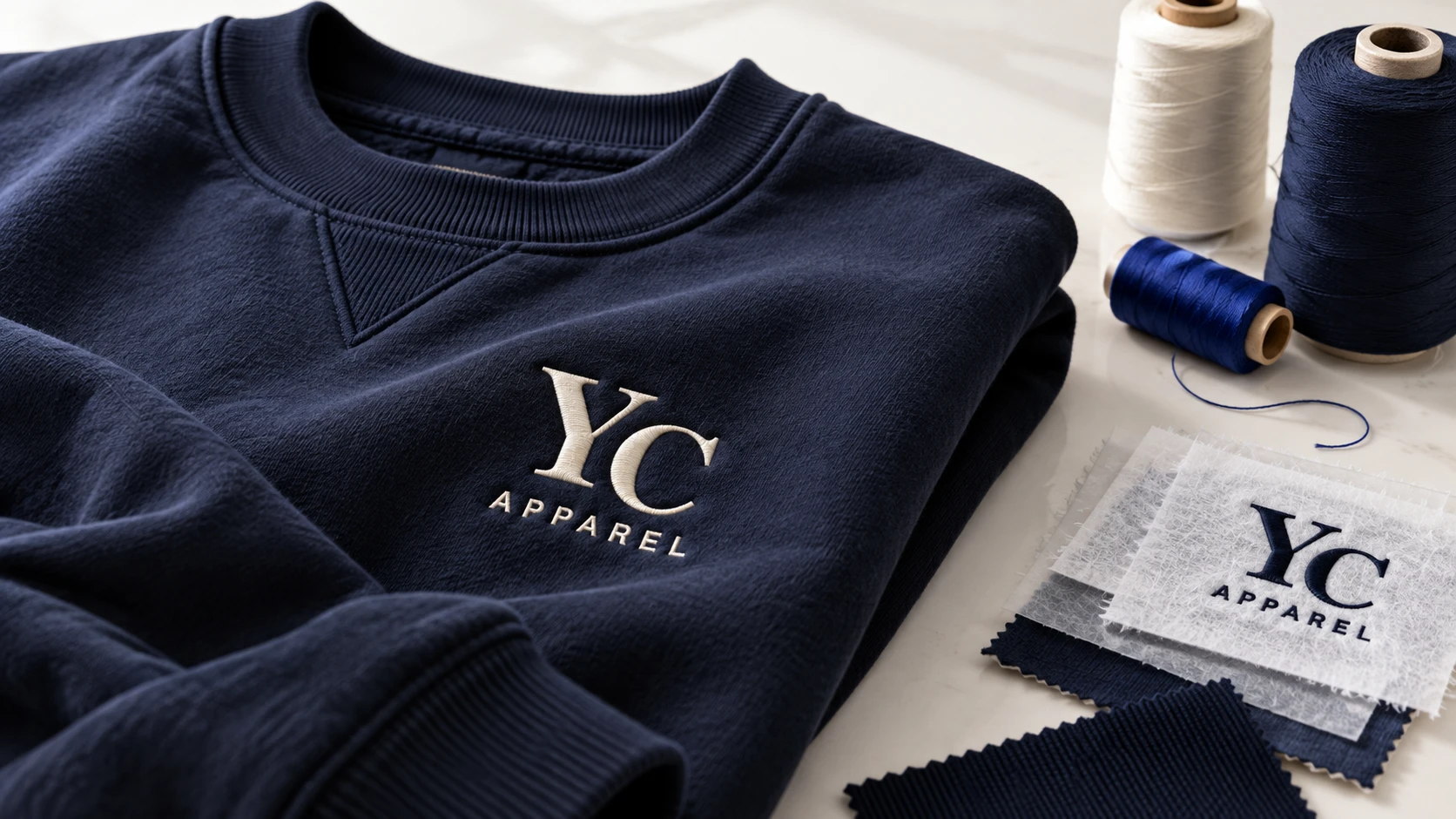
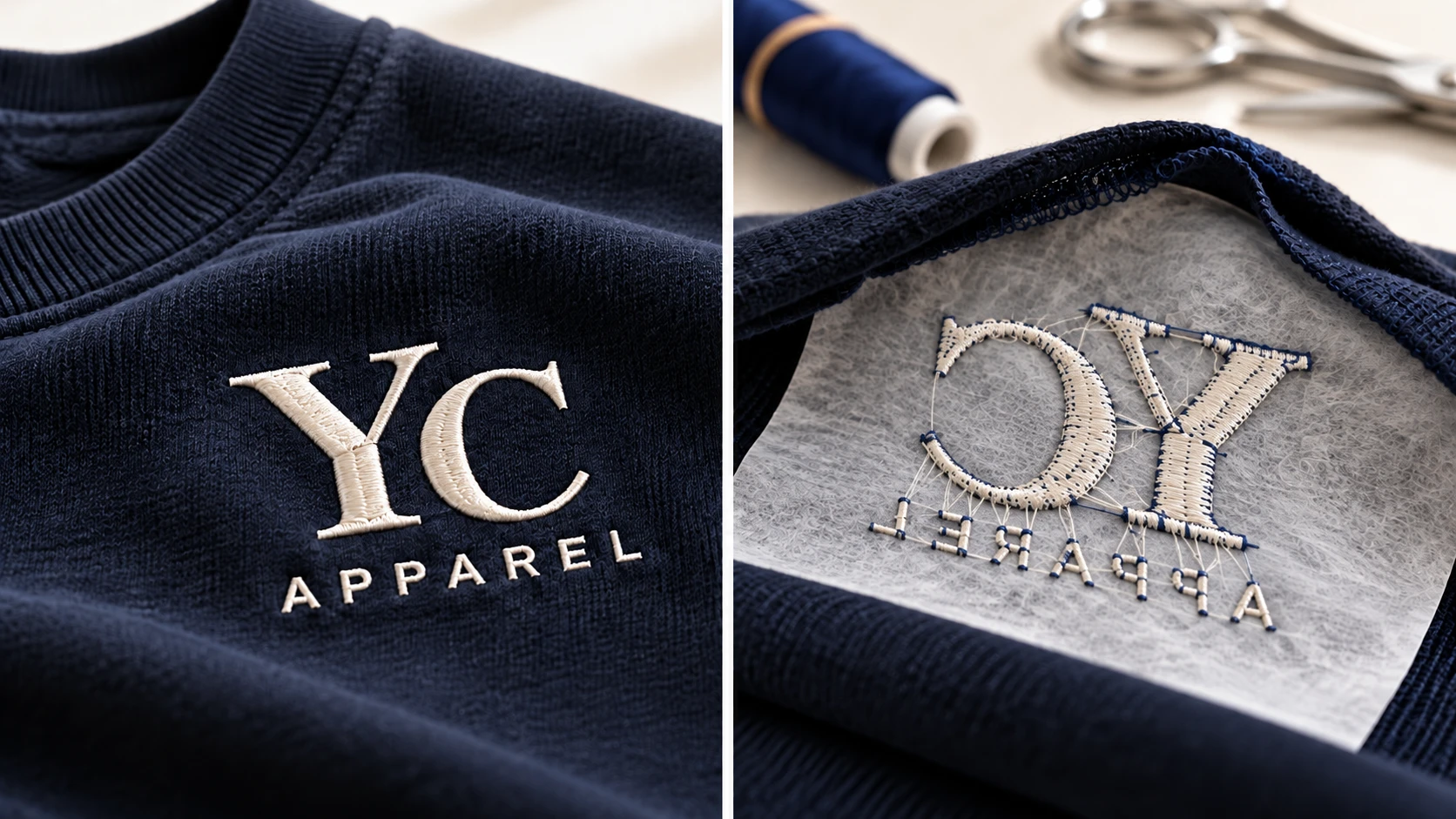
Request the embroidery flat and relaxed, on the garment in its intended worn position, from the reverse, and after the agreed care evaluation. Use the same sample identity across those views. A close-up of stitches cannot show whether a large motif pulls the front of a lightweight T-shirt out of shape.
Madeira describes digitizing, hooping, stabilization and tension as contributors to puckering.[1] These are interacting choices. The buyer should document the objection and intended result before the embroiderer changes the setup.
Check whether the garment was stretched while framed or held unnaturally flat for the photograph. Do not approve a sample solely while it remains in the hoop. If pressing is used, keep a relaxed pre-press view so the improvement is not confused with the original embroidery result.
02
Make the artwork decision at the finished size
Supply a vector or other suitable source file, the intended dimensions and the exact placement. A small mark enlarged on a screen can look readable while its stitched counterpart loses narrow spaces. Ask for an actual-size proof before approving digitizing.
Review dense areas, overlaps, narrow lettering and large filled shapes as specific risks to evaluate. Do not demand a fixed stitch count as a substitute for the embroiderer’s construction judgment. Two designs with the same count can distribute stitches very differently.
If the digitizer proposes simplified lettering or a changed fill direction, compare the revised artwork with the brand requirement. Keep that approval separate from color and placement. A technically stable version that changes the identity of the logo still needs design approval.
| Decision | Record |
|---|---|
| Finished size | Width, height and scale reference |
| Placement | Landmarks and approved garment size |
| Legibility | Smallest lettering and negative spaces to preserve |
| Texture | Fill direction, relief and edge appearance |
| Color | Thread reference and physical approval sample |
| Revision | Source artwork and digitized file references |
03
Treat backing and topping as different decisions
Backing supports the fabric during embroidery; topping serves a different surface role, such as helping stitches remain visible on textured material. Madeira distinguishes these stabilizing functions.[2] Ask which materials are proposed, how they are removed or finished, and what remains against the wearer.
The heaviest backing is not automatically the best answer for a soft garment. Review bulk, edge feel, visibility through pale fabric and the effect on drape. A backing that controls distortion but makes the chest panel rigid may fail the design brief.
Document the actual fabric code, weight, stretch behavior and finishing state. “Cotton T-shirt” does not identify enough about the substrate to transfer an approval from one style to another. If embroidery is applied before a garment wash, include the complete sequence in the trial.
04
Compare a small matrix instead of an unexplained replacement
Ask the embroiderer to identify the suspected contribution and propose a controlled change. That may involve digitizing, stabilization or handling. Keep the material lot and artwork revision constant unless the change is intentional and recorded.
Evaluate each sample after it is released and relaxed. Compare the surrounding fabric, motif edges, thread appearance and reverse. If a revised setup removes ripples but changes the motif dimensions, record both outcomes rather than calling the trial simply better.
A useful hypothetical comparison is Trial A, the original sample, and Trial B, the same artwork and fabric with a documented stabilization revision. If Trial B changes digitizing as well, identify both changes. The buyer may still approve the combined result, but the record should not claim to have isolated one cause.
Four approval gates
- ArtworkActual size, legibility, color and placement.
- ConstructionDigitizing and support suited to the actual fabric.
- WearRelaxed appearance, drape and reverse-side comfort.
- CareComplete garment after the agreed care sequence.
05
Approve what the wearer will receive
Check the reverse for sharp or scratchy edges, loose threads and excessive bulk. Assess how the garment sits when worn; do not confuse a neatly framed swatch with a finished product. Keep care instructions and their supporting evaluation connected to the full decorated construction.
The approved record should identify the fabric, artwork, embroidery file revision, thread references, backing and sample. Ask to be notified before any of those are substituted. If the motif appears on multiple garment sizes, review whether placement or scale changes require additional samples.
For a project discussion, send the logo, intended size, placement and fabric information together. That lets the embroidery partner evaluate the combination. Sending only a photograph and requesting “same quality” leaves too many consequential choices open.
| Check | Approval evidence |
|---|---|
| Front appearance | Relaxed full-garment and detail views |
| Reverse / comfort | Backing finish and wearable sample review |
| Dimensions / placement | Named landmarks and actual-size reference |
| After care | Identified sample and recorded conditions |
| Repeatability | Approved files, materials and change-control owner |
If the desired motif cannot meet the garment brief through the proposed embroidery construction, revisit the embroidery versus screen-printing decision using the same artwork and material.
06
Embroidery sample review record
Connect the visual approval to the fabric, digitizing and stabilization used in the actual sample.
Attach actual-size artwork, full-garment photographs and reverse views. Separate design acceptance from care-performance acceptance. If the embroiderer changes several variables, record all of them so the approved result can be reproduced.
Embroidery sample review record
Complete the working record, export it to continue later, or print your entries. No account is required.
Open the editable record ↗Download blank text brief07
Questions buyers ask
Will fewer stitches always stop puckering?
No. Stitch distribution, design construction, fabric support and handling also matter. A lower count can damage the intended appearance without resolving the underlying combination.
Can I approve embroidery on a separate swatch?
A swatch can approve some design decisions. It does not fully approve garment placement, drape, reverse-side comfort or the complete care response.
Is backing removal part of the approval?
Yes. Review the finished reverse as the wearer will receive it, including what remains, how edges are finished and whether the result affects comfort.
Sources & further reading
Sources checked 18 October 2026. The notes below identify what each source supports. Editorial examples, planning assumptions and illustrations are not supplier test results or official acceptance limits.
- Madeira — How to Avoid Puckering During EmbroideryExplains digitizing, stabilization, hooping and tension factors. This guide does not copy fixed machine settings.
- Madeira — Embroidery StabilisersExplains backing and topping roles; selection depends on fabric and embroidery.