

01 / Start with the wearer
Choose the T-shirt you want to make before choosing its fabric
“Premium cotton” is an incomplete brief. A soft everyday tee, a boxy graphic tee and a close-fitting training top ask different things of a fabric. Define the wearer, silhouette, next-to-skin feel, decoration and care expectations before requesting options.
CottonWorks recommends beginning knit development with end use, performance, aesthetic direction and target price.[1] Translate that into a short request: what should the T-shirt feel like, how should it hang, and what must it still do after washing?
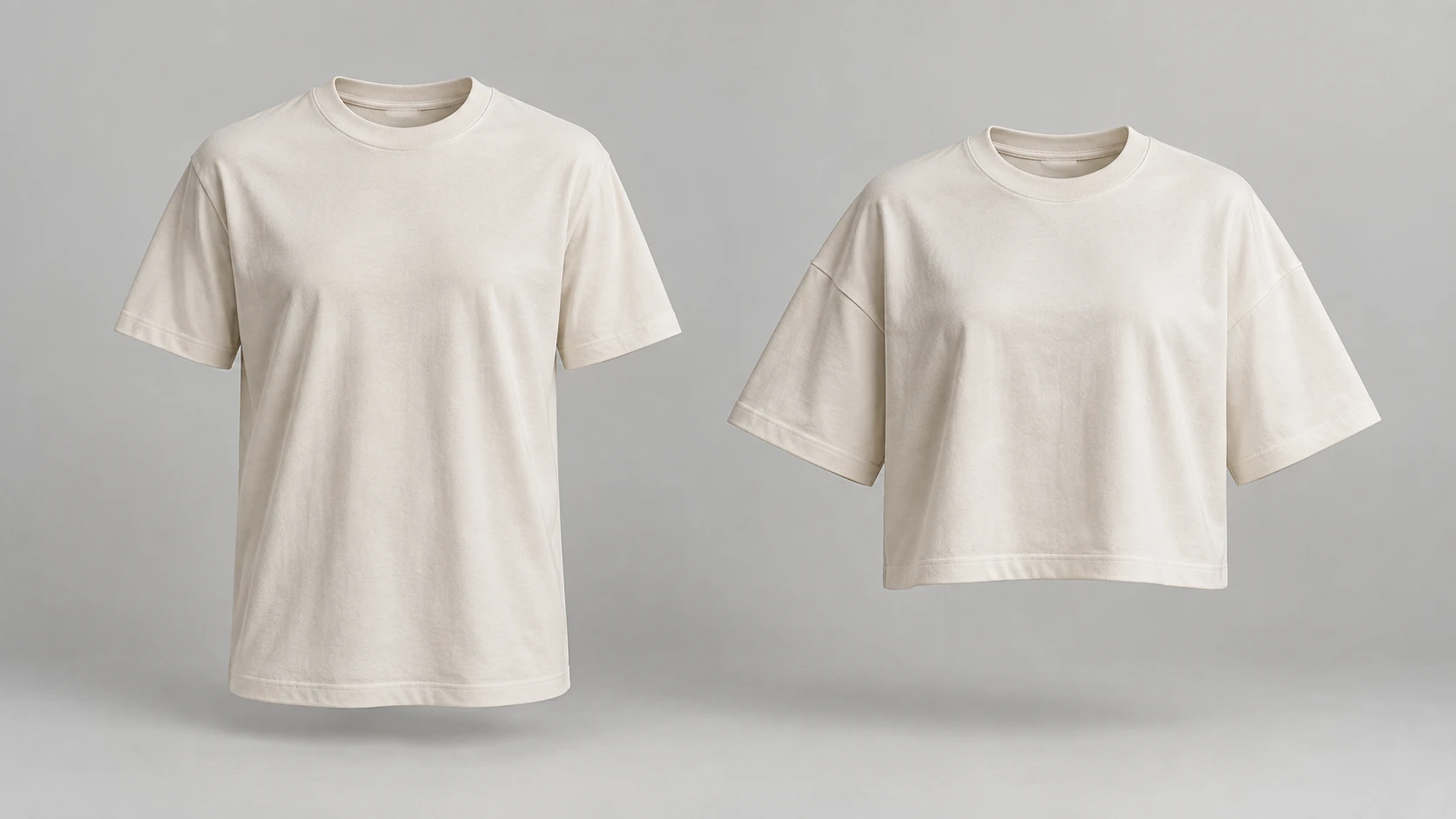
| Product direction | Starting candidates | Decision to verify |
|---|---|---|
| Everyday graphic tee | Cotton or cotton-rich jersey. | Skin feel, surface for decoration and wash appearance. |
| Boxy streetwear tee | Compact, firmer fabrics in the desired composition; compare more than one weight. | Shoulder shape, body drape, opacity and hem behavior. |
| Training or active-use tee | Performance-oriented polyester, blends or engineered cotton options. | Evidence for the moisture or drying claim, plus wear comfort. |
| Close-fitting stretch tee | A knit with the required stretch and recovery; consider an elastane blend. | Recovery after use, opacity when extended and decoration stretch. |
These are sampling directions, not universal recommendations or a list of fabrics currently available from Yuchen.
02 / Read the composition
Cotton vs polyester: choose a material direction, then verify the fabric
Cotton is a natural cellulose fiber; polyester is a manufactured synthetic fiber. Elastane, also called spandex, is used with other fibers to add stretch.[2] These names describe the ingredients. They do not fully describe a finished T-shirt fabric.
Cotton: a useful starting point for an everyday tee
Consider cotton when a cotton hand and an everyday casual product are central to the brief. Cotton fiber absorbs moisture, but absorbency is not a drying-speed result.[2] Review the finished cloth for softness, opacity, dimensional stability and the planned print. “100% cotton” alone does not establish any of those outcomes.
Polyester and cotton/polyester blends: specify the exact option
For a sports-oriented brief, include suitable polyester or blended candidates, then request evidence for the performance you plan to claim. A blend may offer a useful balance for your product, but “poly-cotton” leaves the proportions undefined. Write both fiber names and percentages; a heather appearance is not proof of a particular blend.
Be precise about moisture language. AATCC lists TM195 for liquid moisture management, TM197 for vertical wicking to specified distances, and TM201 for drying rate using a heated plate.[3] Ask which property matters and which method fits it. Do not turn a fiber name into an unsupported “quick-dry” claim.
Stretch blends and other fibers: give each addition a purpose
If a close-fitting tee needs recovery, define the required extension and recovery conditions rather than approving a blend percentage alone. If you are considering viscose, modal, lyocell or a multi-fiber blend for a different hand or drape, request the precise composition and review the same decoration and wash requirements. Keep the shortlist manageable: every additional candidate should answer a specific unresolved need.
03 / Look beyond the label
Yarn, knit and finish explain why similar labels feel different
Two fabrics with the same composition can look and handle differently. CottonWorks identifies yarn selection, knit construction and visual design as separate development decisions.[1] Ask for a traceable fabric code and the yarn and construction details behind it.
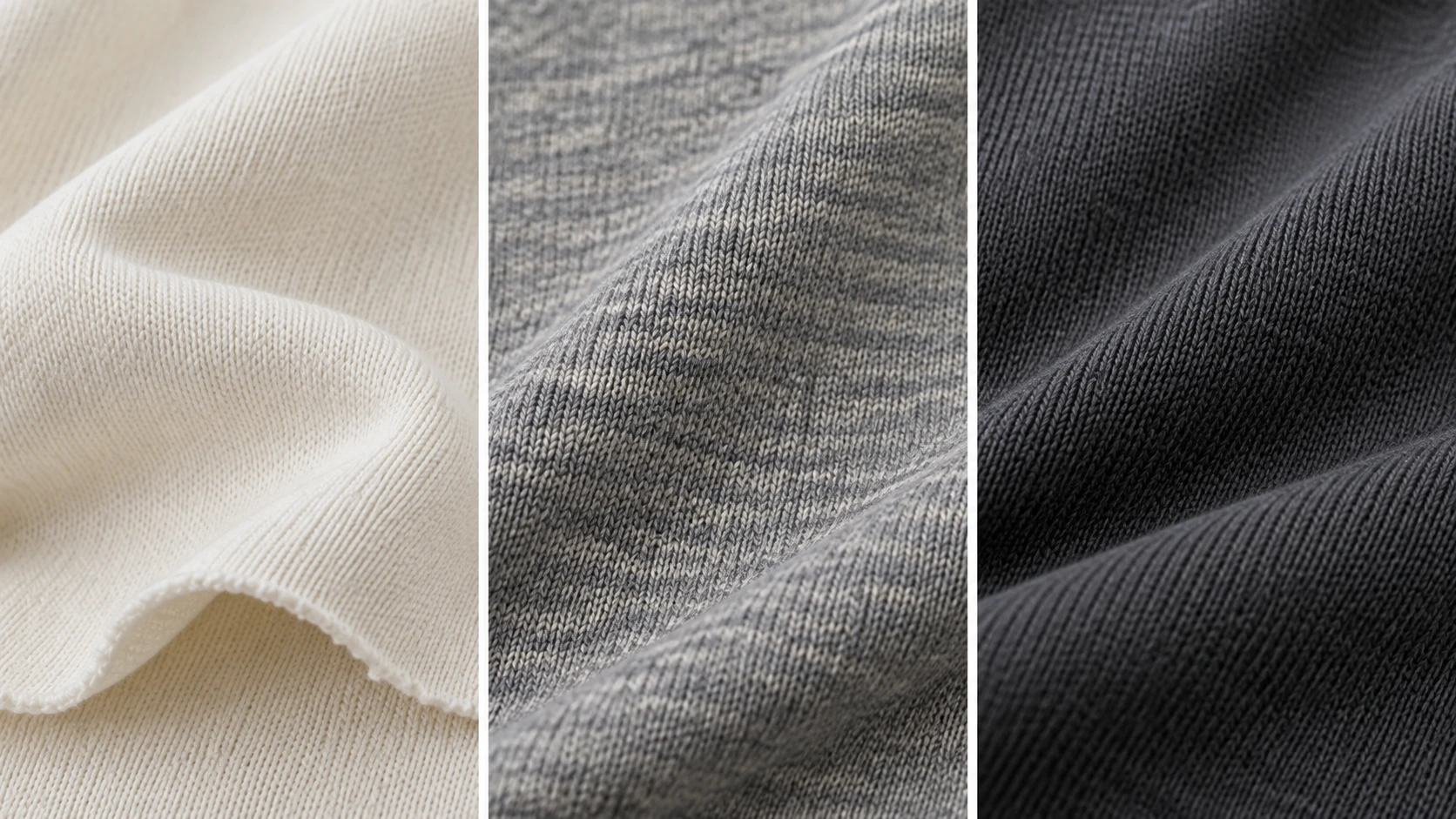
For the body, name the construction—such as single jersey—instead of writing only “T-shirt fabric.” Record any specified yarn type and count with its numbering system. Give the neck rib its own reference. A body fabric description does not specify the collar.
Use a physical reference to explain words such as smooth, dry, supple or firm. Inspect the face in consistent light, stretch it as intended in wear and compare its recovery. If opacity matters, review the intended color on the intended wearer or underlayer; judging a dark swatch does not approve the same fabric in white.
Use GSM as one field in the specification
GSM means grams per square meter. ASTM D3776/D3776M covers measuring fabric mass per unit area; its small-swatch option does not necessarily represent an entire lot.[4] Agree the finished weight, tolerance, condition and verification method. Use our fabric GSM guide for the weight fundamentals.
For a boxy tee, check how the actual fabric supports the intended pattern. Adding weight is not a substitute for approving shoulder shape, drape and comfort. A heavier option should earn its place in the brief.
04 / Choose fabric and decoration together
Approve the print or embroidery on the intended material
A good undecorated swatch is only part of the decision. Give the decorator the composition, color, finish, artwork and intended care process before you commit to the material.
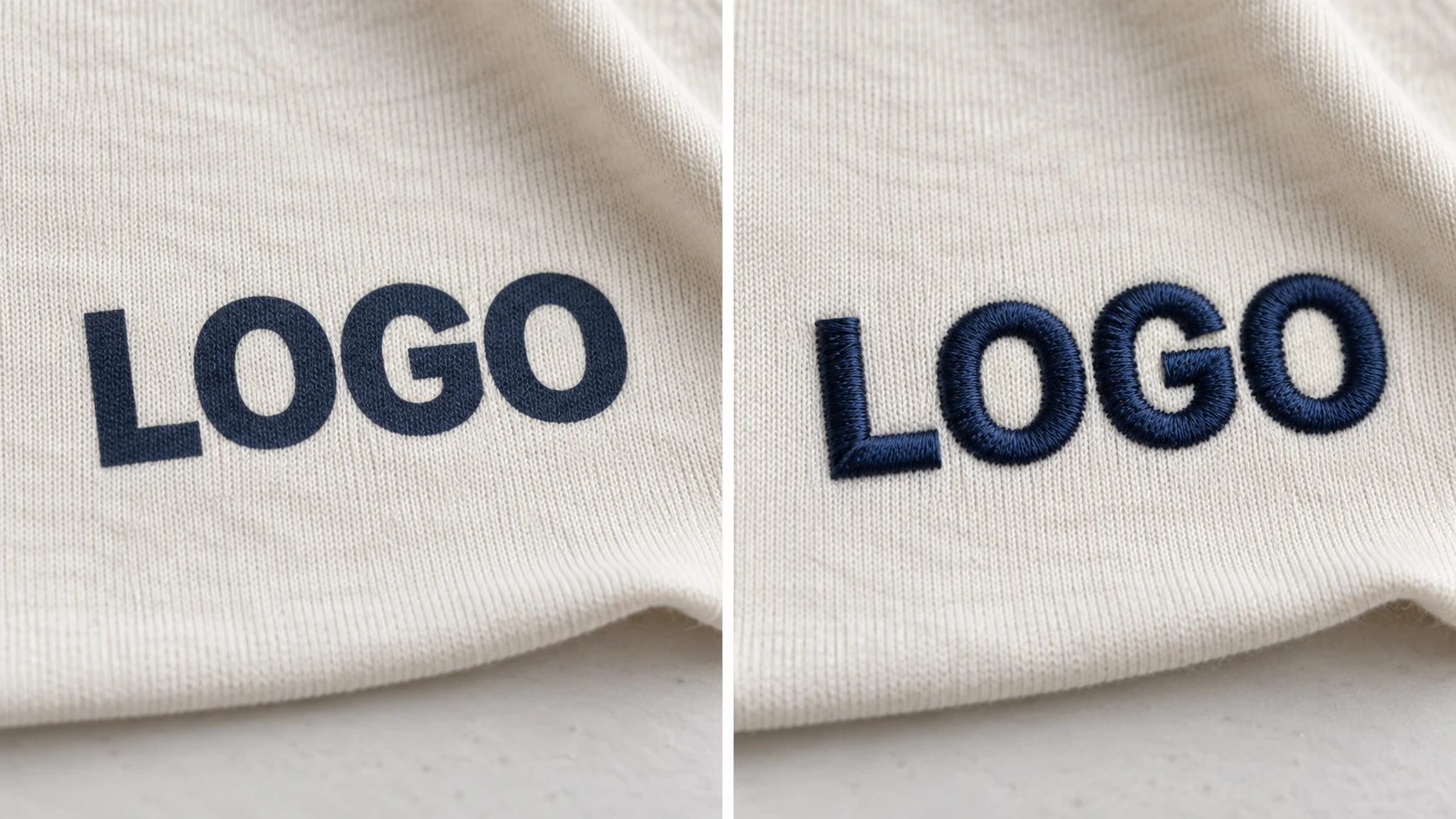
| Process | Material direction | Approval task |
|---|---|---|
| Direct-to-garment (DTG) | Cotton and cotton-rich fabrics are common candidates; supported polyester processes also exist. | Confirm the specific printer, ink, pretreatment and curing route; review the final color and finish. |
| Dye sublimation | White or light-colored polyester or predominantly polyester fabric. | Confirm compatibility and the intended color effect before fabric approval. |
| Screen print / heat transfer | Select a system suited to the particular fabric and color. | Check adhesion, hand and any dye migration under the agreed application and review conditions. |
| Embroidery | Assess the actual fabric with the planned stitch design and backing. | Review puckering, distortion, inside comfort and wash appearance. |
Epson’s guidance supports the DTG and sublimation directions above, including polyester DTG with an appropriate pretreatment system.[5] This is process guidance, not proof that every decorator can print every substrate.
For polyester-containing fabrics, discuss dye migration: heat can allow fabric dye to discolor a decoration. STAHLS’ notes that behavior can vary by fabric and dye lot.[6] Agree an appropriate trial and observation period with the decorator rather than copying a generic temperature recipe.
For a garment-dyed or washed look, approve the intended process sequence too. Fabric, collar, sewing thread and artwork should be reviewed after that sequence—not as unrelated components.
05 / Put quotations on the same basis
Compare fabric price by area before comparing garment cost
A price per kilogram is not a price per meter. Even two kilogram prices can give a different cost per area when weights differ. Normalize the unit first, then evaluate whether both options meet the product brief.
Fictional teaching quotations · USD
A lower price per kilogram can cost more per square meter
| Candidate | Price / kg | Finished GSM | Nominal price / m² |
|---|---|---|---|
| A | $8.00 | 200 | $1.60 |
| B | $7.50 | 240 | $1.80 |
Price / m² = price / kg × GSM ÷ 1,000
For fabric quoted per linear meter, divide its price by the corresponding open fabric width in meters to obtain a nominal area price. Confirm whether a stated width is open width or tubular lay-flat width, and distinguish billed width from usable cutting width. Do not insert a tubular lay-flat width into this simple calculation as if it were open width.
Check your quote units
Use the same currency for both candidates. Enter the width corresponding to the quoted linear meter. This is a unit conversion, not a garment costing tool.
B is 12.50% higher per nominal m² than A.
Starts with the fictional A/B example above. Changing the quote basis clears its size input. Blank or invalid values are not treated as a zero-cost quotation. Results exclude losses and all non-fabric costs.
Request the final garment quotation for the agreed fabric, size mix, quantities, colors and decoration. Ask the supplier to identify any material substitution or allowance that changes the comparison.
06 / Confirm the material in a garment
Keep the approved swatch, decorated trial and wash review connected
Label each candidate and retain an unwashed reference. Review the T-shirt on the agreed wearer or form, then follow the agreed care-review procedure. Record measurement changes separately from changes in hand, appearance or fit preference.
AATCC TM150 addresses garment dimensional changes after home laundering; TM207 addresses seam twist before and after home laundering.[3] Choose relevant checks and acceptance criteria with the supplier or lab. A method title alone does not provide a universal passing limit.
- Before decoration: confirm composition, supplier code, finished weight, shade and reference hand.
- After decoration: inspect coverage, edges, stiffness, distortion and inside comfort where applicable.
- After the agreed wash review: inspect dimensions, twisting, collar behavior, shade, surface and artwork; record the procedure and sample ID.
- Before approval: resolve open points and retain the approved material and garment references with the current specification.
Our clothing sampling guide explains the wider development process. Use the fabric review to make the next sample request specific.
07 / Make the request usable
A one-page fabric brief for custom T-shirts
Keep one current material brief attached to the style. Include the same fields for every candidate so a quotation or sample can be traced back to what was requested.
| Field | What to record |
|---|---|
| Use and appearance | Wearer, silhouette, hand, opacity and physical reference. |
| Material identity | Supplier code, composition percentages, body construction, specified yarn details and separate collar reference. |
| Finished specification | GSM and tolerance, open/usable width, shade, finish and fabric condition. |
| Decoration and care | Artwork/process, trial reference, wash procedure and acceptance criteria to agree. |
| Commercial basis | Currency, price unit, quantity/color basis, minimums, availability and exclusions. |
| Approval | Sample IDs, findings, unresolved questions, next action and signed-off reference. |
Free working brief
From fabric preference to a clear sample request
Fill the brief, compare two candidate swatches and keep a record of the next decision. The blank print layout fits one A4 page; lengthy entries may need additional pages.
The HTML brief works offline and exports notes. Entries are not saved automatically or submitted to Yuchen. Save your record before closing.
Save the offline brief ↓Build a fabric brief for your custom T-shirts
Bring your fit reference, preferred hand and decoration idea to the material discussion. Explore custom T-shirt development or share the brief to discuss suitable options.
Discuss your T-shirt fabric brief →Questions brands ask before choosing T-shirt fabric
Is 100% cotton always the best fabric for T-shirts?
No. It can be a useful starting point for a casual tee, while another composition may better support a particular stretch, decoration or performance brief. Approve the finished fabric and garment against the intended use.
What GSM should a premium T-shirt use?
There is no universal premium weight. Define the desired silhouette, hand and opacity, compare physical candidates, and then record the selected finished GSM and tolerance. Weight alone does not approve quality.
Can polyester T-shirts be printed with DTG?
Some systems support polyester with suitable pretreatment and process settings. Confirm the exact equipment and material compatibility with your decorator and approve a trial.[5]
Should I approve the fabric before seeing a finished T-shirt?
You can select a fabric for sampling first. Keep that separate from final garment approval, which also covers fit, construction, decoration and the agreed care review.
Sources and technical references
Official pages checked 5 October 2026. References support the stated material facts and method scopes; shortlisting advice is editorial guidance. Quote figures are fictional teaching inputs, not supplier or market data.
- CottonWorks: Designing Knit TextilesEnd-use planning and the separate roles of yarn, construction and design.
- Cotton Incorporated: Textile FibersFiber classification, cotton moisture absorption and spandex use. Educational booklet, 2013; not a finished-garment comparison.
- AATCC: Standards directoryScopes of moisture management, wicking, drying, garment dimensional-change and seam-twist methods.
- ASTM D3776/D3776M-20(2025)Fabric mass per unit area and the limits of small-swatch results.
- Epson: A Digital-Printing PrimerDTG and dye-sublimation substrate guidance, including polyester pretreatment. Equipment-vendor guidance, not universal compatibility.
- STAHLS’: Dye Migration HandbookDye migration in polyester-containing garments and the need to test the actual material and application.