
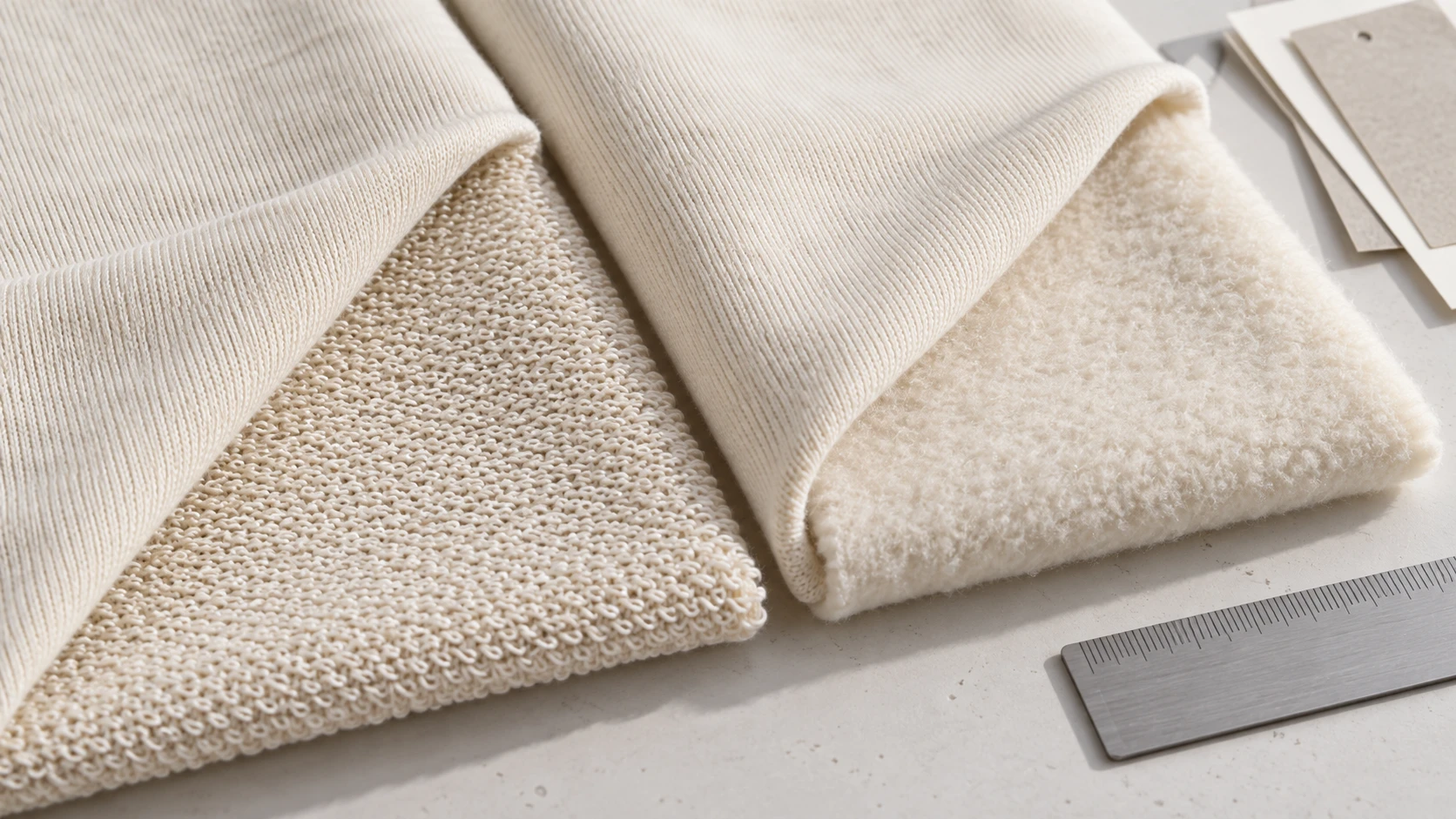
01 / Turn the fabric over
French terry vs fleece: the difference starts on the inside
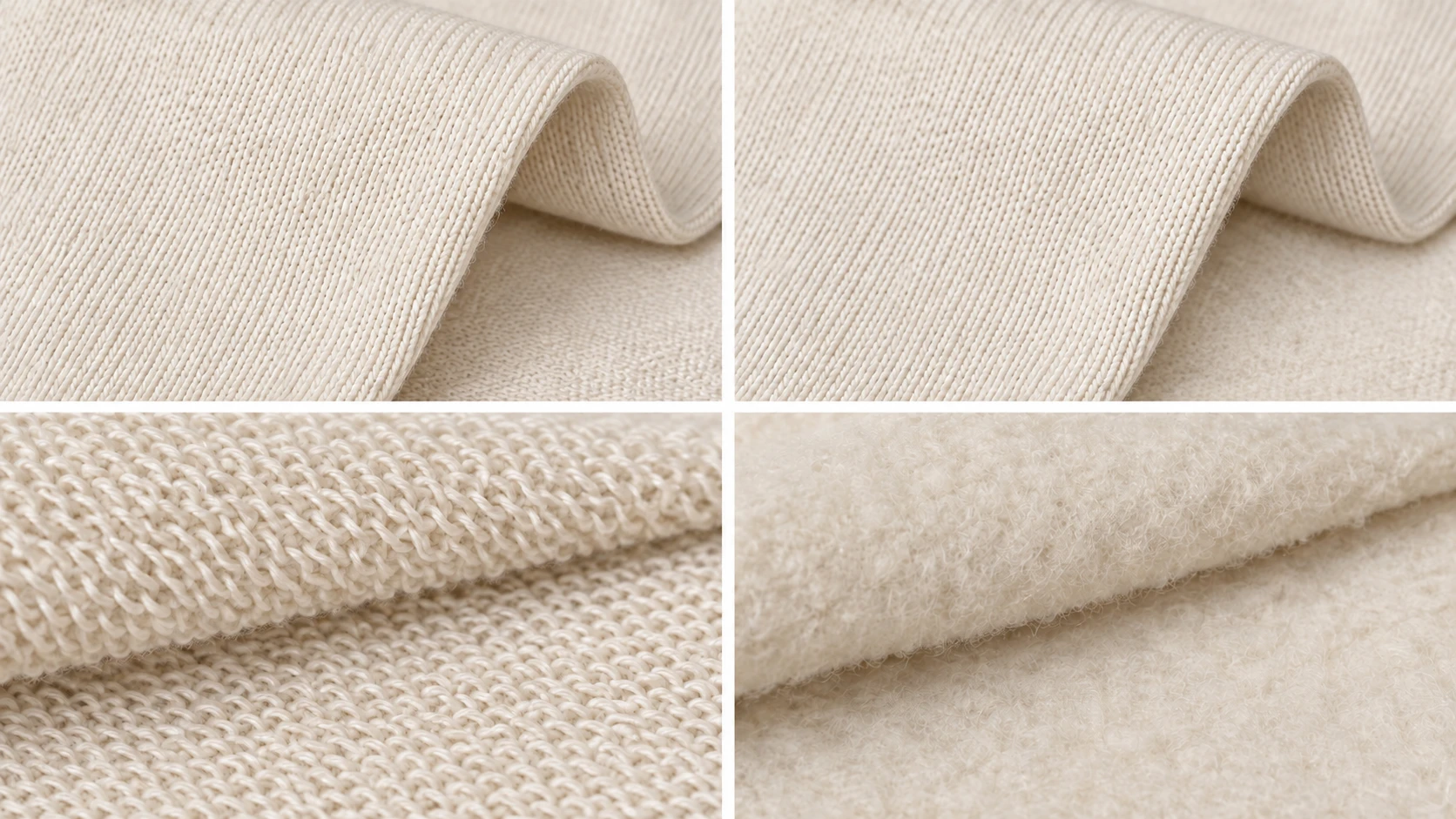
French terry fabric has a jersey face and visible, unbrushed loops on its reverse. Brushed sweatshirt fleece has a raised, fuzzy inner surface. CottonWorks identifies napping of the back as the distinction in its two-end examples; fleece can be cotton, a cotton/polyester blend or synthetic.[1] Read the composition separately from the fabric name.
In this guide, fleece means the brushed sweatshirt fabric used for hoodies and sweatshirts. If a supplier offers a different construction under that name, ask for face-and-back swatches before comparing quotations. A product name alone is not a complete material specification.
| Decision | French terry | Brushed sweatshirt fleece |
|---|---|---|
| Inside texture | Distinct, unbrushed loops. | Raised, fuzzy fibers. |
| Starting design brief | Consider for a loopback interior and everyday layering. | Consider for a plush interior and a cozy sweatshirt feel. |
| What the name leaves open | Fiber percentages, finished weight, thickness, stretch, recovery, drape and wash behavior. | |
| Before you approve it | Check loop feel, snagging during intended use and the finished silhouette. | Check the nap before and after washing, loose fiber transfer and the finished silhouette. |
| Performance evidence | Compare actual samples using agreed methods. Neither name supplies a warmth rating, airflow result or shrinkage limit. | |
The shortlisting and inspection steps in this guide are editorial recommendations. They are not universal performance rankings or factory test results.
02 / Make the comparison useful
Compare similar fabric specifications before choosing a winner
A heavy, densely knitted sample and a lighter, more open sample answer different design briefs. Their differences cannot be attributed to brushing alone. Request a closely matched pair where possible, then record every specification that differs.
- Start with the same intended use. Name the wearer, layering, activity, season and target silhouette. “For Europe” is too broad to describe comfort needs.
- Record the material details. Ask for fiber percentages, knit construction, yarn information where available, finished GSM and tolerance, color and finishing process. Give each swatch a supplier code.
- Compare in the same condition. Use similar panel sizes and orientation, the same lighting and the same pre-wash or post-wash condition. Keep an untouched reference.
- Separate preference from evidence. “I prefer sample A against the skin” is a useful preference. “A is more breathable” requires a defined property and supporting comparison.
Napping is a mechanical finish that raises fibers to create a pile surface; the finishing treatment can vary.[2] Request the intended production finish, not just an attractive substitute swatch. Use our fabric GSM guide to read weight alongside construction and composition.
03 / Define the comfort claim
Warmth and breathability need more than a fabric label
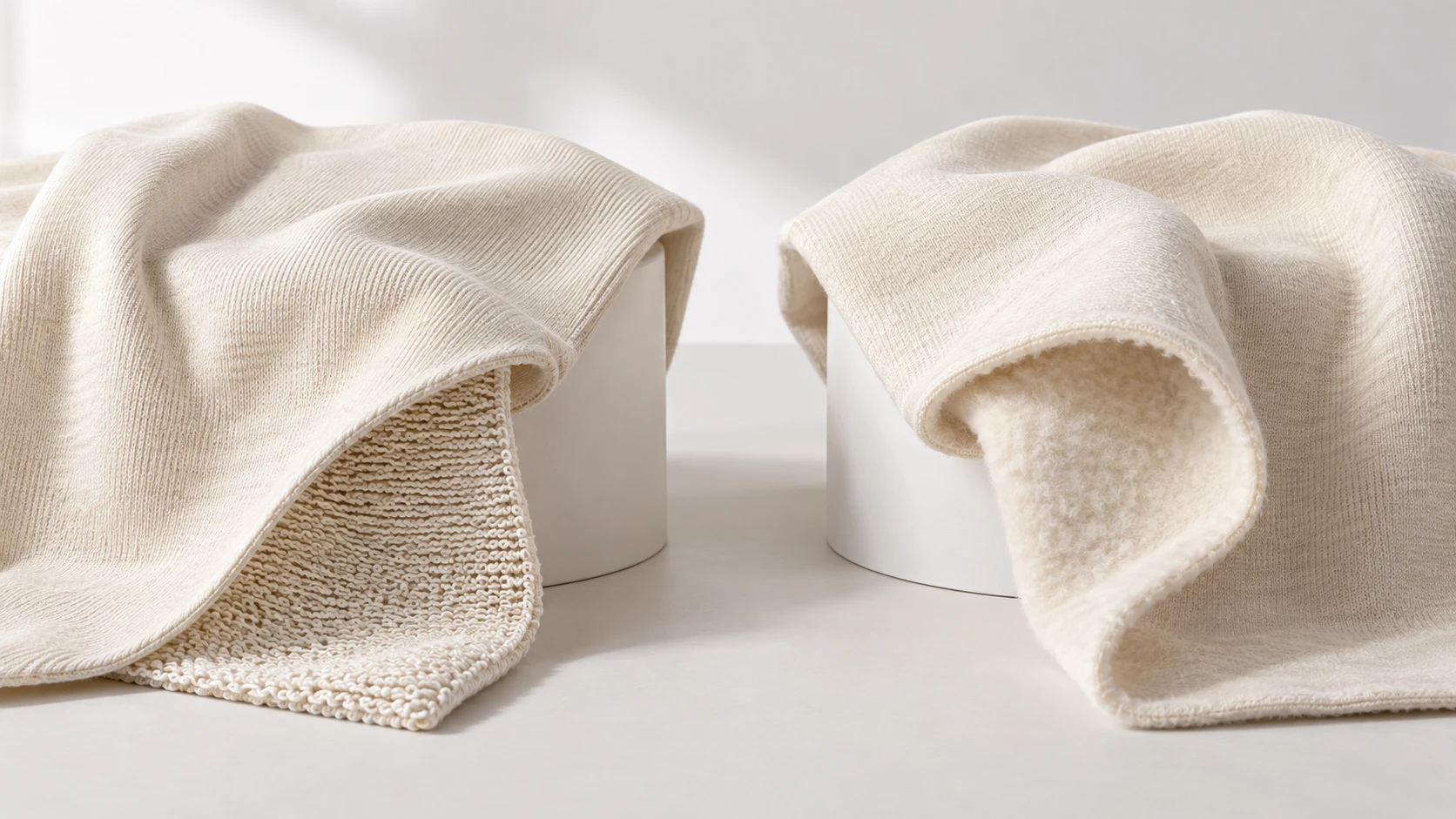
For a plush cold-weather interior, start your sample search with brushed sweatshirt fleece. For a less fuzzy layer, start with French terry. Treat these as design directions: neither establishes how the finished hoodie will perform on a particular wearer.
Ask what “breathable” means in the brief. Air passing through a fabric and water vapor passing through it are different properties. ASTM D737 addresses air permeability, while ISO 11092:2026 addresses thermal and water-vapor resistance under controlled steady-state conditions.[3][4] Neither an airflow number nor a soft hand alone proves quick drying.
| Question | Evidence to discuss | Keep this boundary clear |
|---|---|---|
| Which insulates more? | Comparable thermal-resistance results, such as testing under ISO 11092. | A fabric result is not a guaranteed outdoor temperature rating for a hoodie. |
| Which lets more air through? | Air-permeability testing under an agreed method such as ASTM D737. | Construction and finishing matter; use comparable conditions and units. |
| Which resists water-vapor transfer less? | Comparable water-vapor resistance results under ISO 11092. | Do not substitute an airflow result for this measurement. |
| Which feels right in use? | Wear review in the intended fit, with the intended underlayer. | Record wearer feedback separately from laboratory results. |
If a performance claim will appear on a product page, agree its wording and evidence before ordering tests. Send the lab the actual material codes and intended finish. Ask whether the test specimen should include a lining or other layers relevant to the claim.
04 / Choose for the product
Which is the best fabric for your hoodie?
Choose the sample that meets your brief, then confirm it in the garment. A fabric that looks right on a table may behave differently in a lined hood, a dropped shoulder or a ribbed hem.
| Your priority | What to shortlist | What to check next |
|---|---|---|
| Everyday layering with a loopback interior | French terry options in the desired weight and composition. | Skin feel, movement over an underlayer and the actual hood bulk. |
| A plush, cozy interior | Brushed sweatshirt fleece with the intended finish. | Nap feel after laundering, fiber transfer and comfort in the assembled sample. |
| A boxy or sculptural shape | Both constructions; request equal-size panels. | Drape, fold behavior, shoulder shape and seam bulk. Do not choose by GSM alone. |
| A large print or embroidery | Both, subject to the chosen face and decoration process. | A strike-off or sew-out on the actual fabric, followed by agreed wash review. |
| A measurable comfort claim | Samples whose properties can be tested against the brief. | Comparable reports for the property claimed, plus wear review. |
Print and embroidery: approve the decorated material
Tell the decorator the fiber composition, finish, color and intended artwork. Request a print trial or embroidery sew-out on that material. Inspect coverage, edges, puckering, backing comfort and the result after the agreed wash process. Approval on a different base fabric should not automatically transfer to your chosen swatch.
For custom hoodies and sweatshirts, review the body, hood lining and rib as a set. Do not substitute a new body fabric without revisiting the details affected by its handle, stretch or thickness.
05 / Check what changes
Review wash behavior and surface appearance before approval
Agree the wash procedure, drying method, cycle count, measurement condition and acceptance criteria in advance. AATCC lists TM135 for dimensional changes of fabrics after home laundering and TM150 for garments.[5] A casual wash check can guide development, but it is not automatically a test performed to either method.
Read dimensional change as a measured result
For a single measured direction, calculate (after − before) ÷ before × 100. A negative value indicates shrinkage; a positive value indicates growth. Keep length and width results separate.
Fictional teaching data · one measured direction
Compare results, not fabric names
Bars show shrinkage magnitude; the signed changes are −3% and −2%.
| Sample | Before (cm) | After (cm) | Signed change |
|---|---|---|---|
| A | 50.0 | 48.5 | −3.0% |
| B | 50.0 | 49.0 | −2.0% |
The example separates a measurable outcome from a category assumption. You still need the procedure and acceptance criteria to decide whether a real result meets the brief. Use the comparison sheet to calculate a directional change from your own measurements without turning it into an automatic pass or fail.
Look beyond shrinkage
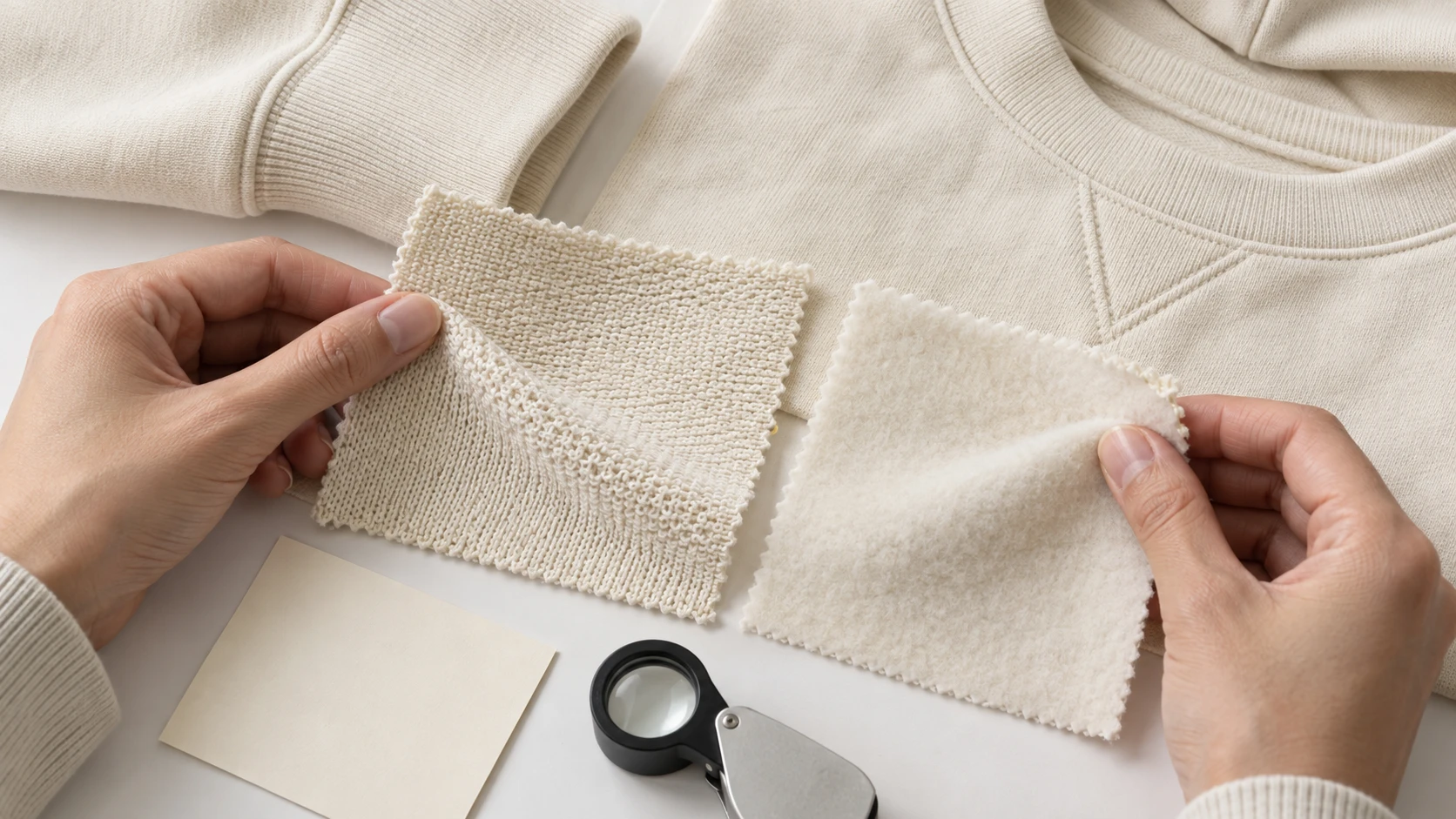
Record twisting, shade change, decoration damage and changes to the inside surface. Photograph the same areas in similar light before and after review. Keep “fuzzy surface,” “loose fiber transfer” and “pills” as distinct observations rather than one vague “quality” score.
If pilling resistance is required, ask the lab to recommend a suitable method and agree the reporting conditions. ASTM D4970 covers Martindale pilling and related surface changes; its official summary cautions against using it for acceptance testing without considering its stated limitations.[6] Do not compare grades from different methods or test durations as equivalent.
06 / Send a usable brief
Request two traceable swatches, then choose with evidence
A useful request names the intended hoodie, what matters to its wearer and what information must accompany each swatch. Avoid asking for “your best fleece” without defining what best means.
Free working tools
Fabric swatch comparison sheet
Record two candidates, calculate directional dimensional change and export your notes. Start blank so an unknown result stays unknown.
The sheet works offline. Download it below to keep a copy. Entries stay only while its page is open; export your notes before closing. Nothing is submitted to Yuchen.
Save the offline HTML sheet ↓Once you have a preferred fabric, follow a documented clothing sampling process to review it in the intended garment. Keep the approved swatch reference and agreed specification with that style.
Have a hoodie fabric direction in mind?
Share the intended use, fit reference and fabric priorities so the material discussion starts with the decisions that matter.
Discuss fabric options for your hoodie →Questions before sampling
French terry and fleece: common questions
Is French terry always lighter than fleece?
No. The names do not set a finished weight. Request the GSM and tolerance for each candidate, then inspect the actual swatches. A category label cannot replace that specification.
Does fleece mean polyester?
No. Sweatshirt fleece can use cotton, blends or synthetic fibers.[1] Ask for fiber percentages and the construction rather than inferring composition from the word fleece.
Can I use French terry for a winter hoodie?
You can include it in the shortlist if it suits the product brief. Review the whole garment, layering and intended use. Do not assign a winter temperature rating from the fabric name or GSM.
Which should I choose for a first collection?
Begin with the wearer experience you want, request traceable options and approve the actual decorated garment. Resolve fabric availability, minimums and price for those specific options with the supplier; neither category guarantees a lower cost.
Sources and technical references
Official reference pages checked 5 October 2026. Standards summaries establish scope, not complete procedures or universal passing limits. The sample-request advice is editorial guidance; the chart uses explicitly fictional teaching data.
- CottonWorks: Single & Double KnitsFrench terry, napped sweatshirt fleece and the distinction between construction and fiber content.
- CottonWorks: Mechanical FinishingNapping as a surface-raising mechanical finishing process.
- ASTM D737: Air Permeability of Textile FabricsAir-permeability testing scope and the relevance of construction and finish.
- ISO 11092:2026Thermal and water-vapor resistance under steady-state conditions using the sweating guarded-hotplate test.
- AATCC: Standards directoryTM135 for fabrics and TM150 for garments after home laundering.
- ASTM D4970: Martindale Pilling and Surface ChangesPilling-test scope and the stated limitations on acceptance testing.
Sample request you can adapt
We are developing an adult pullover hoodie for everyday layering. Please propose one loopback French terry and one brushed sweatshirt fleece option as close as practical in composition and finished GSM. For each, provide the material code, composition, construction, finishing details, weight and tolerance, and available test information. Identify any differences that prevent a like-for-like comparison. We will review hand feel, drape, decoration and agreed wash behavior before approval.