
Private label tags
and packaging.
Small details.
A complete brand experience.
Plan what goes inside the garment, what hangs from it, and how it arrives. Use this guide to turn your brand artwork into a clear production brief.
Care instructions
Required details
BRANDCollection / Style
Layout illustrations, not product samples. Materials and construction are confirmed for each project.
What Yuchen has confirmed
Full custom production, adjustments to existing patterns, and processing and labeling of blank garments are supported.
What to confirm in your inquiry
Label and packaging materials, dimensions, finishes, attachment methods, minimum quantities, pricing and sample timing depend on the project.
Ask about Private Label servicesThe components
Give each detail
a clear job.
The options below are common industry approaches to discuss with Yuchen. They are not a confirmed catalog of available materials or finishes.
Neck labels
Brand identity, close to the garment.
A neck label carries your brand name and may include a size. On trousers, the equivalent brand label may sit inside the waistband.
- Material & finish
- Common options include woven labels, printed fabric labels and direct neck prints. Discuss softness, small-text clarity and compatibility with the garment fabric and finish.
- Size & placement
- Specify finished width × height in millimeters, fold type and stitch areas. Mark the location on a garment sketch, measured from a named seam. Include a separate size tab if needed.
- Files to prepare
- Vector logo, color references, size artwork variants and a placement drawing. Distinguish the visible label size from the unfolded size and seam allowance.
At sample review: check skin feel, edge finish, stitching, orientation and readability after the agreed care trial.
Care labels
Useful information that stays with the garment.
Care labels explain how to care for the finished garment. Composition and other required product information may appear on the same label or on separate labels, subject to the destination market.
- Material & finish
- Printed satin or other suitable label tapes are common options. Confirm softness, print durability and whether a single panel or folded format fits the text.
- Size & placement
- Set the usable text area, total label length and attachment allowance. An inside seam is a common location; identify wearer’s left or right and a measured distance from a seam.
- Files to prepare
- Approved composition, care wording, languages, origin and responsible-business details where required. Supply editable text plus a visual layout. Do not copy the care instructions from another garment.
At sample review: verify the text against the actual garment, including prints, trims and finishes. Read the market notes.
Hangtags
Your retail information, at a glance.
A removable tag can introduce the collection, identify the style and carry size, price or retailer data. It does not automatically replace a permanent garment label.
- Material & finish
- Coated or uncoated paperboard is common. Request a physical stock reference; weight alone does not define thickness or feel. Special finishes and string types need a feasibility check.
- Size & placement
- Provide the cut shape, finished dimensions, hole position and attachment point. Specify string length and attachment method so the tag does not damage or mark the garment.
- Files to prepare
- Front and back artwork, a separate cut line, color references and variable-data mapping by style, color and size. Confirm bleed and safe margins with the selected supplier.
At sample review: check both sides, hole strength, finish rub-off and a physical barcode proof if a code is included.
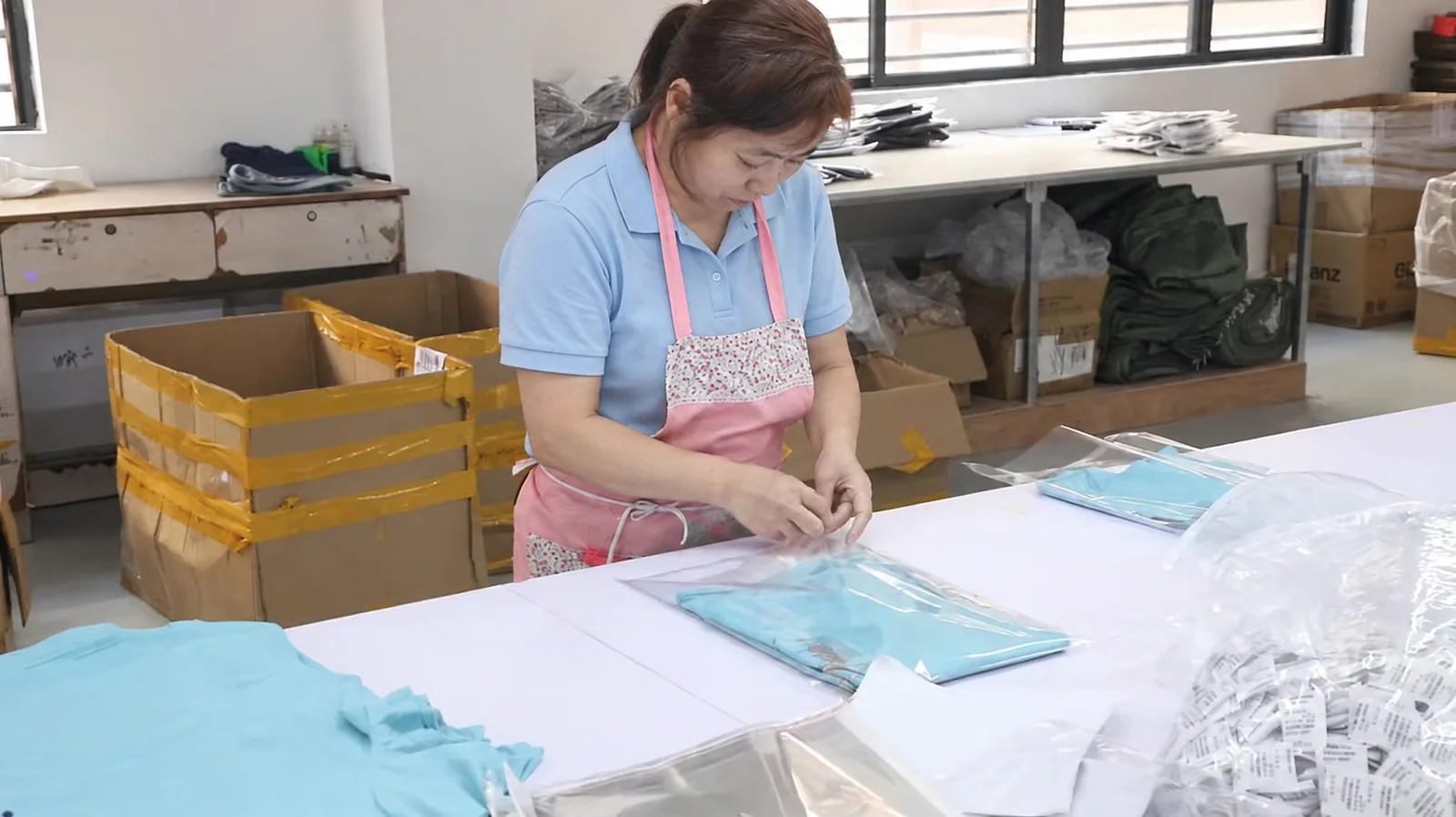
Garment packaging
Protection, presentation and identification.
Individual packaging contains the folded garment; outer cartons serve shipping and handling. Specify these separately so the quote includes the right level of packing.
- Material & finish
- Common approaches include clear garment bags, paper sleeves and cartons. Confirm material, thickness or weight, closure and print method. Environmental claims need supporting evidence for the actual material.
- Size & placement
- Start with the garment’s folded width, length and thickness. Specify usable internal dimensions, opening direction, closure allowance, artwork area and sticker position.
- Files to prepare
- Packaging artwork, fold reference, units per pack, size/color packing breakdown, shipping marks and destination requirements. Include any retailer packing manual.
At sample review: pack the actual garment, close the package, check fit and visibility, then confirm the carton packing plan.
Artwork preparation
Send a specification.
Not just a logo.
A useful file set makes scale, placement and revisions unambiguous. Confirm the final production file format with Yuchen.
Editable + viewable
Provide a vector source such as AI, EPS or SVG and a PDF preview. Outline fonts or agree how to supply them. Keep required text editable in a separate file for review.
Millimeters + a drawing
Show finished size, fold/cut lines, seam allowance and print area separately. A garment photo with arrows is useful when each measurement starts from a named seam.
A reference to match
Give color references and any physical swatch. Screen colors are a starting point; review the sample on the selected material before approval.
One approved revision
Name files by style, component and revision, for example TS01_neck-label_v03.pdf. Keep a size/color data sheet and mark superseded files clearly.
For a folded label, “50 × 20 mm visible” is different from “50 × 20 mm before folding.” These are illustrative dimensions, not a Yuchen standard.
Sample confirmation
Approve the detail.
Then the whole garment.
Use this suggested review sequence when agreeing your project. Ask which physical samples and checks are included in the quote.
Review the artwork proof
Check spelling, dimensions, colors, fold lines, front/back orientation and data variants. Record the revision and unresolved items.
Inspect a physical component
Review material feel, print or weave clarity, edges and finish. A digital mockup cannot confirm these qualities.
Check it on the garment
Review label attachment, skin contact, hangtag position and the packed garment. Agree any care or durability checks and how results will be recorded.
Record approval for production
Confirm the final artwork, physical reference, quantities and packing breakdown in writing. Ask Yuchen to confirm the effect of changes on cost and timing before proceeding.
Destination & retail requirements
The destination
changes the brief.
Tell Yuchen where the garments will be sold and whether a retailer has its own labeling manual. These notes are a starting point for review, not a compliance approval.
Care and product information
For covered apparel in the US, FTC guidance requires permanently attached, legible care instructions supported by a reasonable basis. Most textile and wool products also require fiber content, country of origin and the identity of the manufacturer or another responsible business.
Review the actual garment and current requirements with the responsible importer or a qualified adviser. Other markets may use different language, content and placement rules.
Barcodes and variable data
Supply the retailer-approved identifier and a style/color/size mapping. Confirm the code type, scanning environment and final print size before placing artwork. GS1 guidance identifies symbol size, clear space around the code and print quality as important checks.
Do not stretch a barcode or build it from decorative lines. Ask for a printed proof and agree verification appropriate to its use; a successful phone scan alone does not establish barcode quality.
Official references reviewed September 21, 2026. Recheck requirements before approving production artwork.
Your inquiry, ready to discuss
Bring the
details together.
Select the files you have ready, add your project outline, and download a text brief to include with your inquiry.
Local brief tool. Nothing is uploaded, submitted or sent to Yuchen. Download your brief, then attach it to an email. Email buttons open your email app; they do not send automatically.
Ask about Private Label servicesBefore you send
A few useful answers.
Can I start with only a logo?
You can share a logo as a starting point. Include the garment type, expected quantity and target market, and ask Yuchen which additional specifications or artwork services are needed. Artwork development fees and services must be confirmed.
Do labels and packaging share the garment MOQ?
Do not assume they do. Ask for separate minimums for each component, artwork version, color and size, plus any setup charges. Confirm how unused components will be handled before ordering.
Can the same care label be used across a collection?
Only after reviewing each garment’s composition, construction, trims, finishes and destination requirements. Similar-looking garments can need different instructions. Keep the approved text linked to each style and revision.
Does approving a digital proof finish the process?
A digital proof confirms layout and content. Agree which physical label, garment and packaging samples you need to check before production approval, and record any agreed tests or tolerances.