
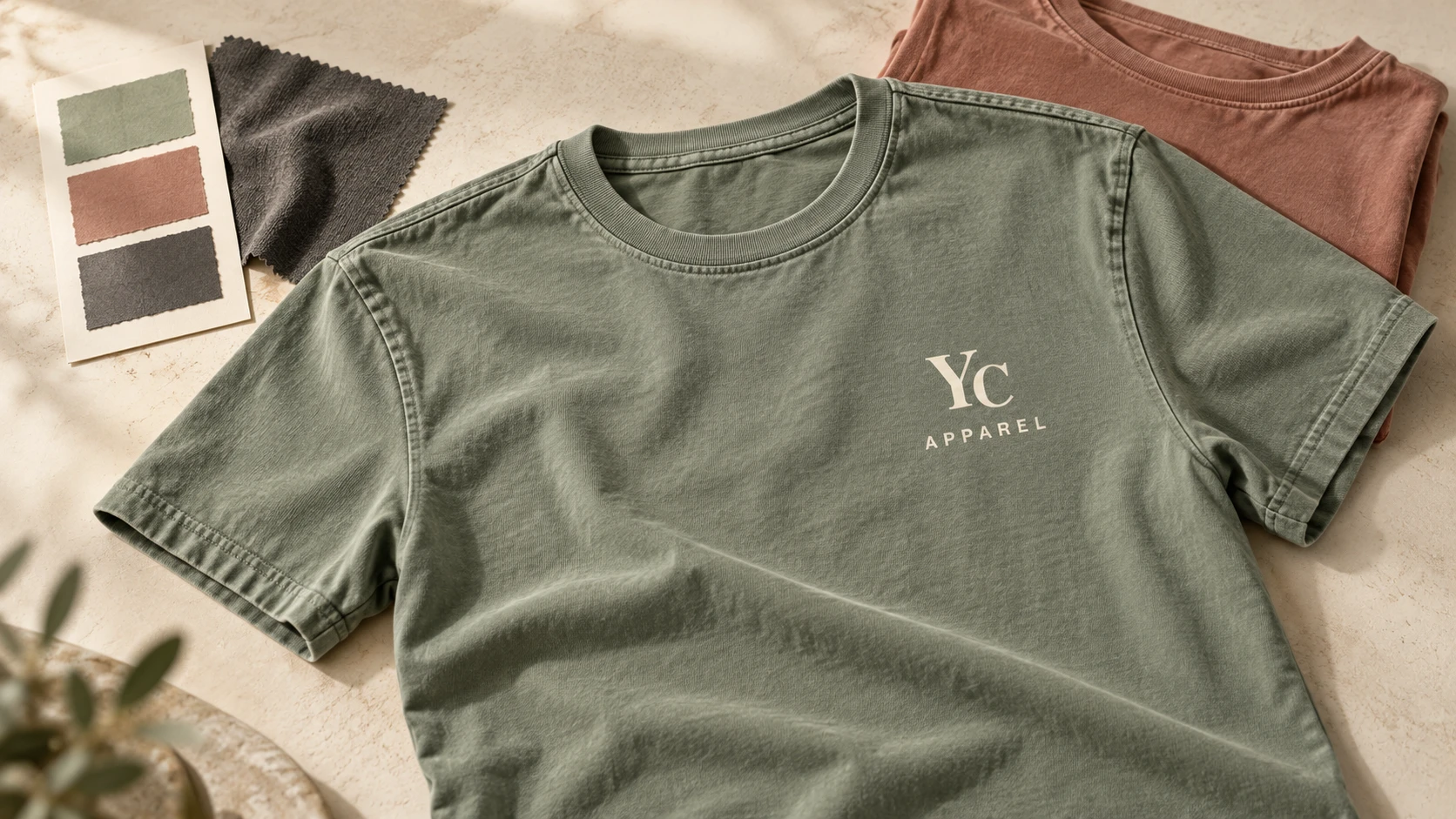
01 / Start with two different questions
Garment dyed meaning: when color is applied
Garment dyed means the garment receives its color after the fabric has been cut and sewn. CottonWorks defines the term by this production stage.[1] It tells you when coloration happens; it does not identify one particular dye chemistry, shade, texture or level of fading.
For a clothing brand, that distinction changes the brief. “Garment-dyed charcoal” still leaves important decisions open: the colorant system, the required surface effect, the behavior of the rib and sewing thread, and the finished measurements. A photograph alone cannot settle those questions.
Garment dyed
Coloration after cutting and sewing.
Pigment colored
Insoluble color particles, normally held to the textile with a binder.
What does pigment dyed mean?
“Pigment dyed” is a common commercial description for pigment coloration. CottonWorks explains that pigments are insoluble, lack natural affinity for fibers and require a binder to attach them to the material.[2] That is different from identifying the stage at which a garment receives its color.
A garment can therefore be both garment dyed and pigment colored. CottonWorks documents garments colored with mineral pigments, providing a practical example of this overlap.[3] Ask the supplier to name both the production stage and the proposed coloration system.
02 / Decode the product description
Garment dyed vs pigment dyed: compare the right things
| Term | What it describes | What it does not establish |
|---|---|---|
| Garment dyed | Color applied after the garment is assembled. | The colorant system or a guaranteed vintage appearance. |
| Pigment dyed | A pigment coloration system. | Whether coloration occurred on fabric or on the sewn garment. |
| Piece dyed | Fabric colored in piece form, before garment assembly. | A particular final hand feel or wash performance. |
| Garment washed | A washing or finishing treatment on the sewn garment. | That new color was added during that treatment. |
For example, a tee made from already-colored fabric can receive a garment wash without becoming a garment-dyed tee. Likewise, specifying garment dyeing does not automatically specify pigment coloration. Keep the process description separate from the visual target.
An example development route
- 1Prepare & assembleChoose compatible fabric, rib and components.
- 2Color the garmentConfirm the dye or pigment system.
- 3Finish & reviewAssess shade, seams, hand and dimensions.
Illustrative sequence. The supplier must confirm preparation, decoration, labeling and finishing order for the actual style.
03 / Describe the finish you want
Turn “vintage” into observable requirements
Words such as vintage, washed and faded are useful mood descriptions, but weak approval criteria. A buyer may mean a muted overall color; a finisher may interpret the same word as strong seam contrast or an uneven surface. Describe those features individually.
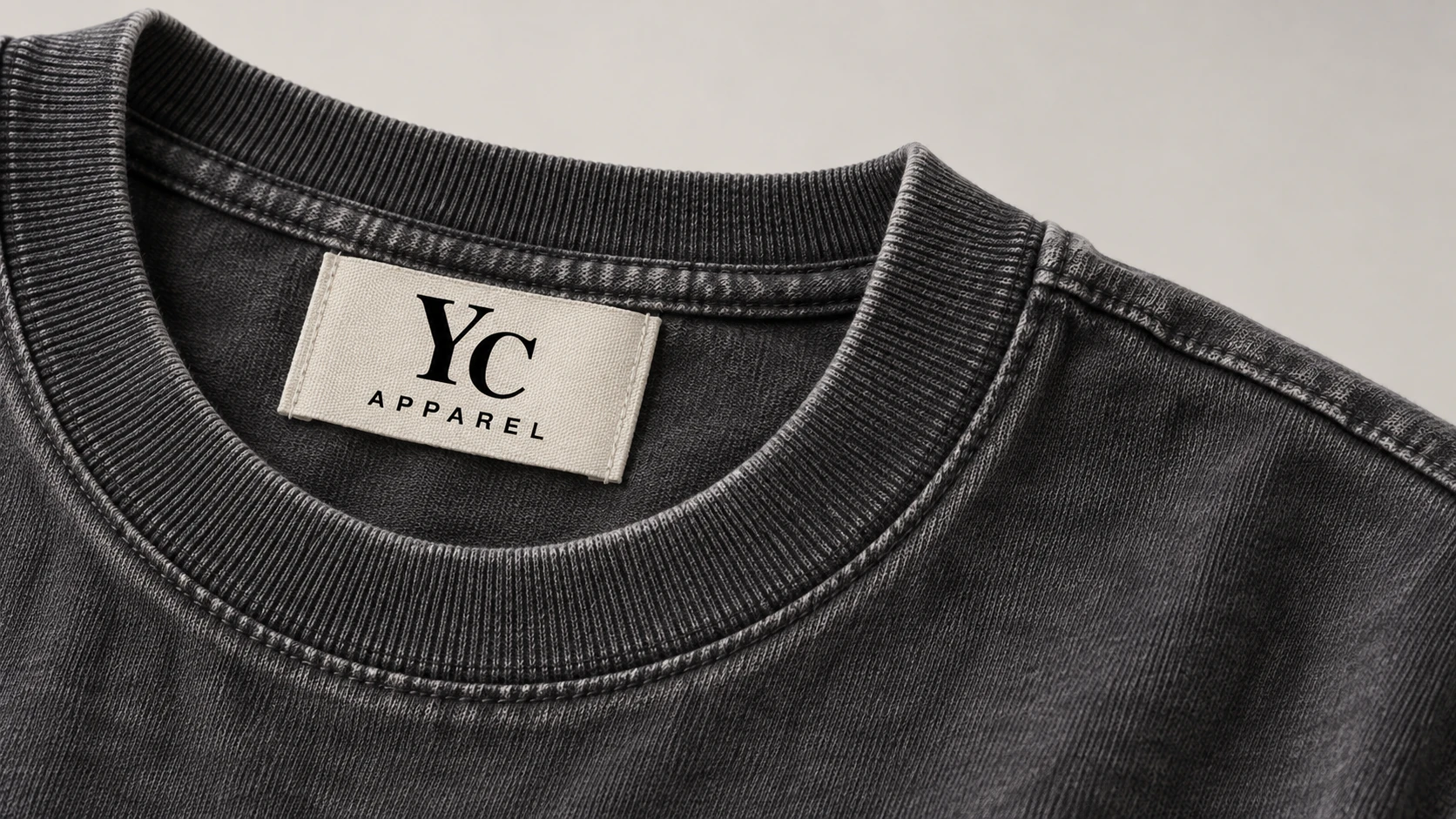
- Body color: identify the physical reference and the lightness or undertone you want.
- Seam contrast: specify where highlights are intended and how pronounced they should be.
- Surface variation: distinguish a subtle irregular effect from unwanted blotches, streaks or stains.
- Hand feel: compare softness, stiffness and surface feel on a finished sample.
Do not approve softness from a process name. CottonWorks notes that excessive pigment binder can affect fabric hand.[2] The useful question is how the proposed system feels on your material after all finishing steps.
Set a shade range before discussing bulk variation
Keep an identified target sample and, where variation is expected, agreed boundary samples. Review them together under the agreed viewing conditions. Use photographs for communication, while retaining physical references for color decisions.

Record whether the agreed variation applies within one garment, between garments in a batch, or between repeat orders. “Each piece is unique” should not replace a decision about unacceptable panels, stains or mismatched sets. Ask how shade groups will be identified and packed when that matters to your collection.
04 / Review the whole garment
Rib, thread, labels and prints need their own check
Matching fiber names do not guarantee matching color. Coats explains that differences in cotton quality and finish can make fabric and sewing thread take up dye differently during garment overdyeing.[4] Agree whether visible thread should blend into the body or create deliberate contrast.
| Component | Ask before sampling | Inspect after finishing |
|---|---|---|
| Body and rib | Are both suitable for the proposed process? | Shade relationship, feel, recovery and neckline shape. |
| Sewing thread | Is a tonal or contrast result intended? | Visible stitch color and seam appearance. |
| Labels and trims | Which are attached before or after finishing? | Staining, legibility, appearance and function. |
| Print or embroidery | When is decoration applied, and on what surface? | Color, alignment, hand and behavior after agreed care. |
For a printed chest logo, record whether the intended effect is a clean graphic over a washed base or a graphic that changes with the finish. Approve the proposed sequence on the actual garment. A successful print on an unfinished swatch does not approve a different finished surface.

05 / Separate appearance from performance
Does garment-dyed clothing shrink or fade?
The label alone cannot answer either question. Factory processing and later consumer care are different stages. Measure the completed sample, then evaluate it after the agreed laundering procedure. Record the method, conditions and acceptance criteria before calling a result acceptable.
| Question | Relevant method scope | Buyer decision |
|---|---|---|
| Does color transfer by rubbing? | AATCC TM8 evaluates rubbing transfer using dry and wet test cloths.[5] | Agree conditions and required grades with the lab. |
| How does color respond to washing? | AATCC TM61 addresses accelerated laundering colorfastness.[6] | Select the applicable option and assessment criteria. |
| Does the garment change size? | AATCC TM150 addresses dimensional change after home laundering.[7] | Agree care conditions, measurement points and limits. |
These summaries use the public method scopes, not the full paid procedures. A method name alone does not set a universal pass limit or replace a laboratory test plan.
Read a dimensional-change result correctly
Suppose a finished tee measures 70.0 cm before the agreed care procedure and 68.6 cm afterward at the same point. Its change is −2.0%. That is a teaching example, not an expected shrinkage rate for garment-dyed clothing.
Try the arithmetic
Dimensional-change calculator
Use the same units and measurement method before and after care.
Change (%) = (after − before) ÷ before × 100
Negative = smaller; positive = growth. This calculation does not perform a test or decide pass/fail. Compare each measurement with its agreed limit.
Keep body length and chest width as separate results; one does not stand in for the other. Also record twisting, neckline shape and decoration changes. A size measurement alone will not describe everything the wearer notices.
06 / Make the brief reviewable
Write a garment-dye brief the supplier can act on
Start with the garment specification, then add the desired effect and evidence required for approval. For custom streetwear or custom T-shirts, keep material, shade and decoration decisions linked to the same style revision.
Example wording to adapt
“Target: a muted charcoal body with subtle seam highlights. Use physical reference FIN-01 for the visual direction; confirm the proposed garment-stage coloration system. Submit a complete sample with the intended rib, thread, labels and chest artwork. Agree shade boundaries, care conditions and dimensional limits before bulk approval.”
Fictional brief example. FIN-01 is a placeholder, not an available reference or an approved process.
The editable sheet below records the finish target, component sequence, physical references, tests and open decisions. It keeps visual acceptance separate from production authorization. Use it alongside your clothing sampling plan.
Garment color & finish review sheet
Fill it in, export your notes or print the completed record. Entries stay in your browser and are not automatically saved.
Open the editable sheet ↗Ready to discuss a finish? Share your garment specification and physical-reference details. Confirm the feasible route and sampling requirements for the particular project.
07 / Common questions
Garment dyeing questions
Is pigment dyed the same as garment dyed?
No. Pigment describes a coloration system; garment dyed describes the production stage. A garment may satisfy both descriptions.
Does garment dyed always mean a faded look?
No. The term does not specify a vintage effect. Describe the body shade, seam contrast, surface variation and hand separately, then approve a physical sample.
Will the color keep changing after purchase?
The process label cannot predict the amount of change. Evaluate the proposed garment under agreed care and rubbing conditions, and base care instructions on the validated product.
Can I add a logo to a garment-dyed T-shirt?
A decoration route may be possible, but confirm the artwork, finished surface and operation sequence. Approve a complete decorated sample, including its appearance after the agreed care procedure.
08 / Evidence & reading
Sources and scope
Primary references checked on 17 October 2026. The workflow and review sheets are editorial tools. Images illustrate concepts; the calculation uses explicitly fictional measurements.
- CottonWorks — Garment DyeingDefinition by production stage.
- CottonWorks — Dyeing BasicsPigment insolubility, fiber affinity, binder and hand.
- Cotton Incorporated — Mineral Pigment ExamplesExamples of garments colored with pigments; no environmental superiority claim is adopted here.
- Coats — Apparel FAQsReasons for shade differences between fabric and thread during cotton garment overdyeing.
- AATCC TM8 — Colorfastness to CrockingPublic scope for rubbing color transfer; full procedure not reproduced.
- AATCC TM61 — Colorfastness to LaunderingPublic scope for accelerated laundering; full procedure not reproduced.
- AATCC TM150 — Dimensional Changes of GarmentsPublic scope for home-laundering dimensional change; full procedure not reproduced.