
01 / Start with the effect
What is puff print—and what should a brand specify?
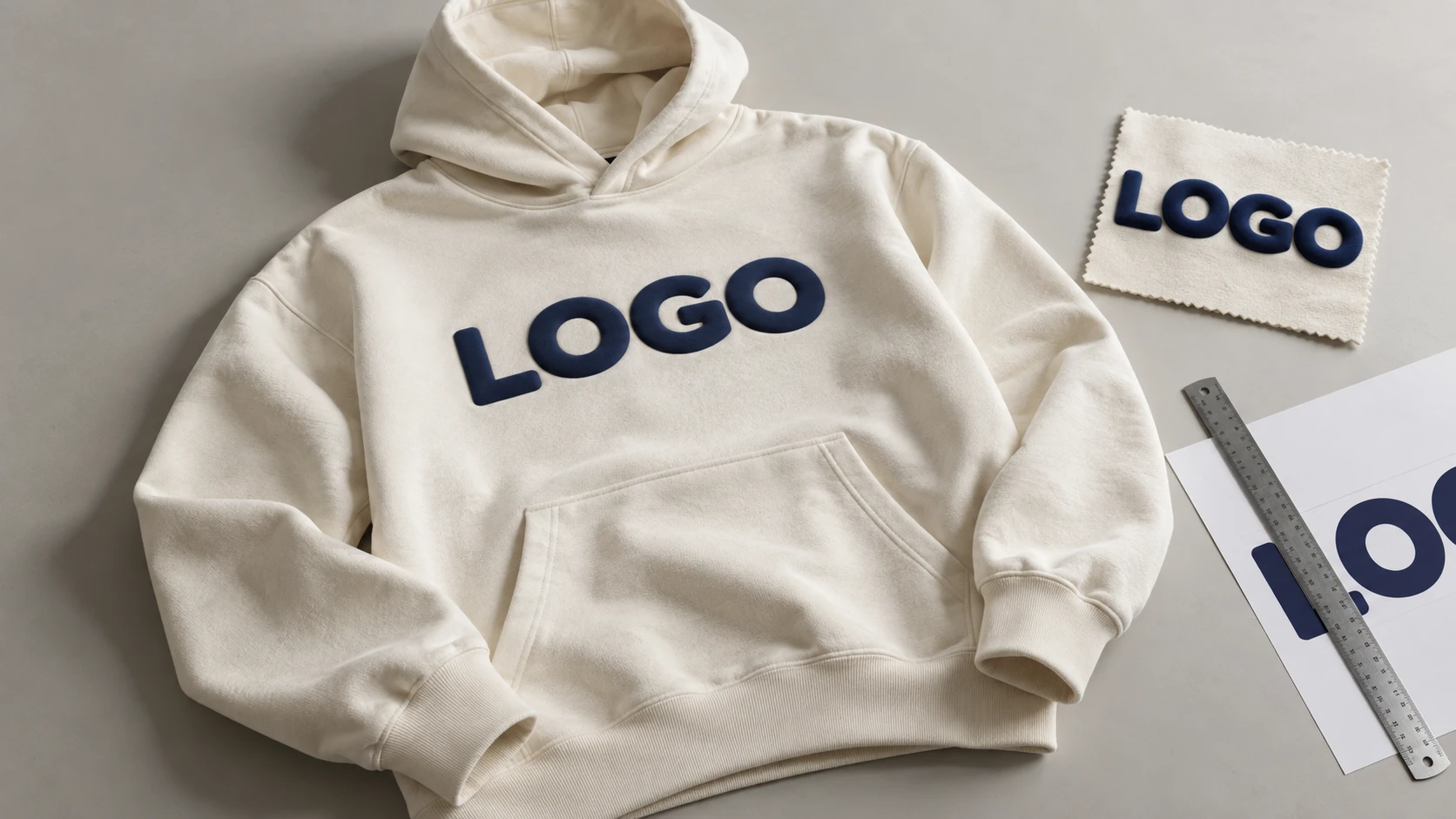
Puff screen printing creates a raised surface by using an ink system that expands with heat. FN-INK’s technical introduction describes heat-responsive particles that make the printed deposit rise.[1] For a clothing brand, the useful specification is the finished effect: how rounded, textured, flexible and prominent the artwork should look and feel.

A flat artwork file does not describe the third dimension. Send a physical reference where possible, then identify what matters: rounded edges, visible relief, open letter interiors and the desired hand. If you specify height numerically, agree how, where and under what pressure it will be measured; a photograph cannot establish an exact height.
| Term in a brief | What to confirm |
|---|---|
| Puff screen print | Expanding ink printed through a screen; identify the proposed ink system and approved physical effect. |
| Puff heat-transfer vinyl | A separate heat-applied material route. Its cutting and application instructions belong to that product. |
| “3D logo” | An appearance request, not a complete process specification. Ask whether the proposal is puff ink, a transfer, embroidery or another raised decoration. |
STAHLS’ UK, for example, lists an 8 mm minimum line thickness for its named Puff HTV product.[3] That product-specific cutting instruction is not a minimum line width for every puff screen print. Ask your decorator to mark the limits for the proposed process on your actual-size artwork.
02 / Design at the final size
Protect the spaces inside and between the letters
Start a first puff trial with bold, separated shapes. Inspect narrow strokes, small text, enclosed spaces such as the center of an O, and gaps between neighboring elements. These are the places where a raised version may stop reading like the flat design.
Mark which elements must puff and which can remain flat. A fine subtitle need not use the same raised treatment as the main wordmark. In its demonstrated layered print, ScreenPrinting.com notes that applying fine detail over an already expanded puff area can be difficult.[4] Let the decorator propose the print order and demonstrate the combination.
| Artwork feature | Request before sampling | Check on the sample |
|---|---|---|
| Small letters or fine outlines | Propose a bolder version, a larger size or a flat detail layer. | Can the intended words and edges still be read? |
| Tight gaps and letter interiors | Show revised spacing and openings at final output size. | Do the spaces remain distinct after processing? |
| Large solid areas | Compare a solid version with a broken-up treatment if suitable. | Does the fabric lie and move as intended? |
| Multiple colors / flat and raised layers | Separate the layers and identify the proposed sequence. | Check registration, color boundaries and the height relationship. |
A smaller logo also has smaller gaps
Do not approve the chest logo and assume a scaled sleeve version is automatically suitable. In this mathematical example, reducing artwork from 300 mm to 180 mm makes every linear feature 60% of its original size. A 5 mm stroke becomes 3 mm; a 4 mm gap becomes 2.4 mm. These are artwork dimensions before printing, not minimums or predicted puff expansion.
Teaching geometry · no print-test data
300 mm → 180 mm
Check an artwork resize
Enter dimensions from the same artwork file. The calculation assumes uniform scaling and does not approve printability.
Take the resulting dimensions to the decorator for a trial. No universal pass/fail limit is applied.
03 / Keep the garment in the decision
Sample the actual fabric, color and placement
A successful swatch on one fabric does not approve a different hoodie or T-shirt. Record the material code, composition, finished weight, color and finish, alongside the artwork revision. Include garment washing or dyeing in the proposed process sequence.
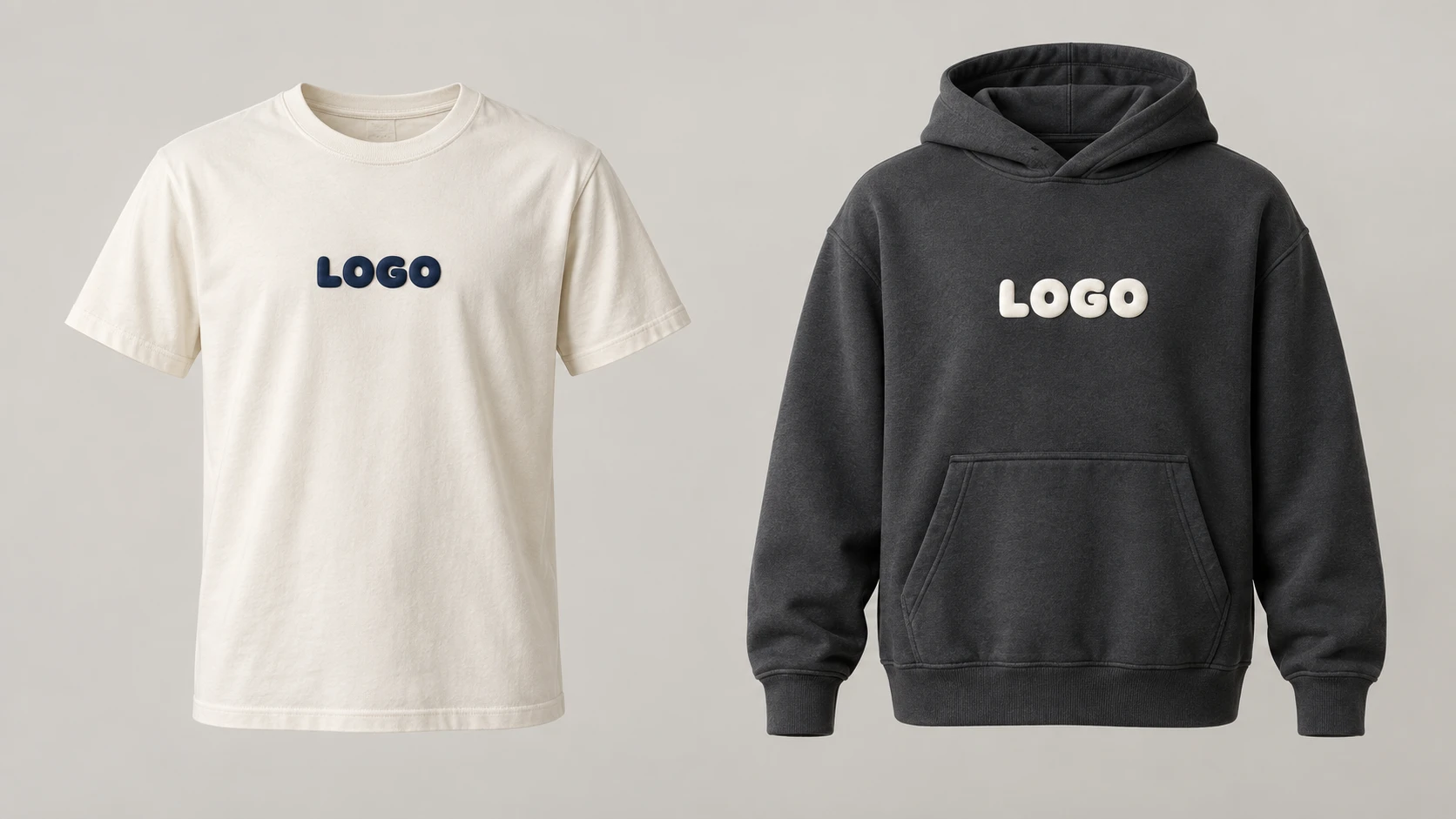
Avient’s NuPuff bulletin lists cotton, cotton blends and some synthetics, while still requiring application testing. It also warns that a large printed area can pucker lightweight fabric.[2] Treat the combination of fabric and coverage as the trial, rather than selecting a material by fiber name alone.
For polyester-containing garments, ask how dye migration will be assessed. STAHLS’ explains that fabric dye can discolor heat-applied or screen-printed decoration and that behavior varies, including between dye lots.[6] Keep the actual shade and lot identifiable; an attractive print immediately after processing is only one observation.
On hoodies, identify pocket edges, seams, zips and rib transitions on the placement drawing. Ask the decorator to confirm access and a suitable printing area. Specify the print’s finished size and its position from named garment landmarks, including any changes across sizes. Our clothing sampling guide explains how that request fits into garment development.
04 / Describe a result the supplier can reproduce
Send more than a screenshot of a puff print hoodie
A mood image communicates direction; an approval brief records the decisions. Annotate the reference instead of asking for “exactly this” without specifying which qualities matter.
- Artwork: editable vector where available, outlined lettering, separated colors, revision and final dimensions. Identify all puff and flat elements.
- Appearance: approved color reference, desired edge character, surface texture and physical relief reference.
- Garment: fabric/color identity, size range, placement drawing and proposed wash or finishing sequence.
- Sampling: variants to compare, required photographs, physical sample destination and care-review conditions.
- Quotation: quantities by style and color, print locations, sample/setup costs, production costs and what changes trigger a new trial.
Approve color on the processed sample. Avient notes that its NuPuff specialty base can lighten a tint.[2] A screen color or an unprocessed ink mix is therefore not the finished-color approval reference.
Leave ink percentages, mesh selection, deposition and curing to the decorator’s documented process for the selected system. FN-INK’s own guidance warns that excessive heat can collapse its puff.[1] “Make it hotter for more height” is not a dependable design instruction.
05 / Review the sample in three stages
Approve the surface, then the garment, then the care result
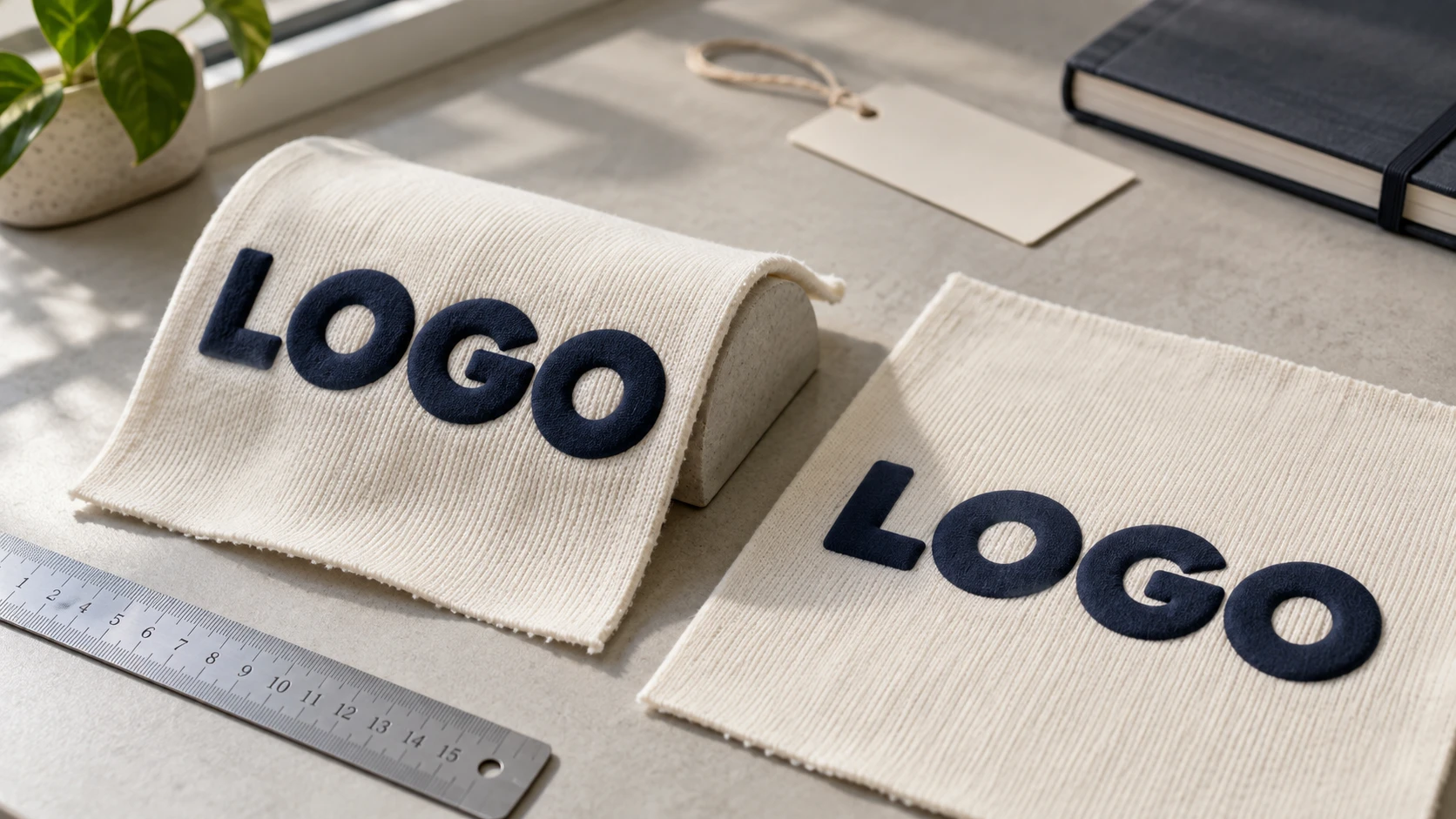
Retain an unwashed reference. Label every trial with the artwork revision, material, color, sample ID and date. Review the physical piece under consistent light, using front and oblique views to separate color, edge definition and relief.
Surface
Readability, gaps, edge definition, color and consistency of the intended relief.
Garment
Placement, fabric distortion, hand and movement at the printed area.
Care
Appearance after the agreed procedure, compared with the retained reference.
Agree washing and drying conditions, cycle count, evaluation points and acceptance criteria before testing. Record cracking, flaking, separation, color change, loss of relief and fabric distortion separately. Do not turn an unspecified wash check into a promise of “50 washes.”
AATCC TM61 evaluates colorfastness to accelerated laundering.[5] Its scope is not a universal puff-height or service-life guarantee. Ask the lab or decorator which procedures address your requirements, and keep method results distinct from your visual approval.
| Observed issue | Useful next request |
|---|---|
| Letter interiors close up | Mark the affected letters; compare a revised opening or spacing at the same finished size. |
| Relief looks uneven | Identify locations and sample IDs; ask for a process review and another comparable sample. |
| Fabric gathers around the artwork | Compare coverage or layout changes on the same material before changing multiple variables. |
| Print discolors or deteriorates | Record when it appeared and the care history; request investigation with the actual material and ink-system records. |
These observations are not a diagnosis from a photograph. Close each open issue with a revised sample or an agreed change. Keep the signed-off reference with the production brief.
06 / Make the next sample request specific
Download the puff print brief and review sheet
Use one record to connect the design request, supplier proposal, physical sample and revision decision. Blank results remain undecided; the sheet does not automatically approve a print.
Free working tool
A clear handoff from artwork to sample review
Record the process, dimensions, fabric, desired effect, care-review plan and findings. Export your notes to keep them with the artwork file.
Works offline. Entries are not sent to Yuchen or saved automatically. Export before closing.
Save the offline sheet ↓Discuss the artwork with the garment brief
Explore custom streetwear or hoodie development, then share the intended effect, artwork and garment details. Ask the team to confirm feasibility and the sampling route for your specific design.
Discuss your decoration brief →Questions brands ask about puff print
Is puff print the same as puff vinyl?
No. This guide focuses on screen-printed expanding ink. Puff HTV is a separate heat-applied material. Identify the proposed system before comparing artwork limits, application instructions or samples.
Can puff print use small text or a detailed logo?
It needs a trial at the final size. Consider enlarging or simplifying raised elements, opening gaps, or keeping fine information in a flat layer. Do not use a universal minimum line width in place of a process-specific review.
Can puff print crack or flatten after washing?
It can change if the material/process/care combination is unsuitable. Record the actual issue and have the decorator investigate. Approve wash appearance and relief using agreed conditions rather than a generic durability claim.
How should a puff print garment be washed?
Follow care instructions validated for the finished garment and its decoration. Ask the supplier to confirm washing, drying and ironing restrictions for the actual system before labeling the product.
Sources and technical references
Official manufacturer, supplier and standards-body pages checked 5 October 2026. Product guidance applies to the named system. The design-review workflow is editorial guidance; the resizing example is geometry, not production data.
- FN-INK / ScreenPrinting.com: Take Your Prints to the Third DimensionHeat-activated expansion, system-specific heat sensitivity and pre-production testing. Supplier technical guidance, 2022.
- Avient: ASI NuPuff Product Information Bulletin, V1.12Substrate guidance, tint lightening, lightweight-fabric puckering and application testing. Bulletin revised May 2025; not a universal puff specification.
- STAHLS’ UK: Puff Heat Transfer VinylThe named HTV product’s 8 mm minimum line-thickness instruction. Not a screen-printing limit or an endorsement of general wash-life claims.
- ScreenPrinting.com: Exploring Dimensional Puff PrintingFirst-hand demonstration of layered puff printing and the difficulty of overprinting detail after expansion, July 2024.
- AATCC TM61: Colorfastness to Laundering—AcceleratedPublic purpose and scope only. The complete paid procedure was not reviewed; this is not a puff-height or lifetime guarantee.
- STAHLS’: Dye Migration HandbookDye migration affecting transfers and screen-print inks on polyester-containing fabrics, including material and dye-lot variation.