
01
First, name the defect correctly
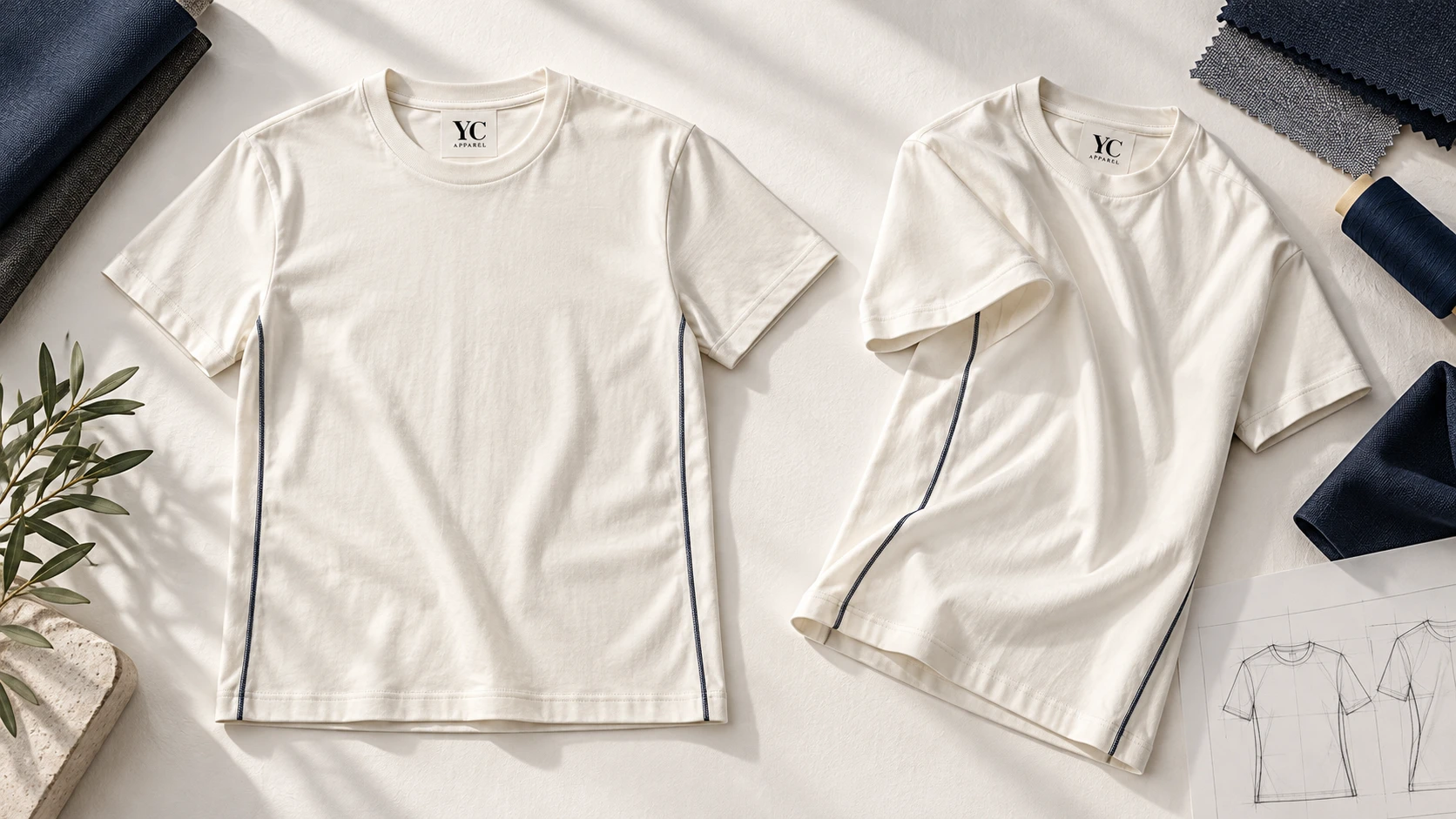
Lay the relaxed garment flat without pulling its side seams into position. Look at the hem, the direction of the knit columns and the relationship between front and back. A seam can be straight but rotated around the body. A wavy seam is a different observation; a shorter body length is another.
Cotton Incorporated describes knitted-fabric torque in relation to yarn and knitting variables. Its technical discussion helps explain why the garment can rotate when internal stresses relax; it does not prove the cause in an individual returned T-shirt.[1]
Write the observation before writing the explanation. “The left seam moves onto the front near the lower hem after washing” is useful. “The operator sewed it wrong” closes the investigation before anyone has examined the fabric.
| Observation | Record | Do not assume |
|---|---|---|
| Seam moves around the body | Front/back position and change from baseline | That seam tension is the cause |
| Body becomes shorter or narrower | Named points of measure before and after | That shrinkage and rotation are interchangeable |
| Stitches or surrounding cloth ripple | Location, seam type and appearance before washing | That every ripple is fabric spirality |
02
Build a before-and-after record you can trust
Give each sample a unique ID. Record the fabric code, dye lot, size, production stage and whether it has already been washed or pressed. Photograph the front, back and both side seams on the same flat surface. Keep the camera square to the garment; an angled photograph can exaggerate the apparent displacement.
Agree the wash, drying and relaxation conditions with the supplier or laboratory. Preserve an unwashed reference from the same lot where possible. Record the conditions actually used, including any deviation, rather than attaching a care-label photograph and assuming that describes the experiment.[4]
Do not smooth the seam back to its original position to make the garment photograph well. Equally, do not stretch the hem to make the defect look worse. Record how the garment was laid out so another person can repeat the observation. If pressing changes the appearance, keep the unpressed view and identify the pressed view separately.
A repeatable observation sequence
- IdentifyGarment, fabric lot, size and initial condition.
- DocumentFront, back, side seams and close-up landmarks.
- LaunderUse the agreed procedure and record deviations.
- CompareReview relaxed samples against the original record.
03
Ask questions in the order evidence can answer them
Start upstream. Request a retained fabric sample and information on the fabric orientation used for cutting. Ask whether the same behavior appears in more than one garment from the lot. If all affected pieces share a material lot, that is a lead to investigate—not proof that every sewing operation was correct.
Next compare the cutting layout with the actual panels. A marker drawing alone does not show how cloth was spread or aligned. Then compare assembly records and seam positions before washing. A garment already rotated at the initial stage needs a different discussion from one that changes mainly after laundering.
Avoid demanding one universal remedy such as “steam harder” or “use less yarn twist.” Ask the technical team to propose a controlled trial and explain what each trial is meant to isolate. The buyer’s job is to define the objection and approval evidence; process changes belong with the people who can inspect and reproduce the construction.
| Stage | Useful evidence | Question it helps answer |
|---|---|---|
| Material | Retained fabric, lot identity, direction markings | Does the fabric itself show directional distortion? |
| Cutting | Actual panel orientation and spreading record | Were panels aligned consistently? |
| Assembly | Unwashed garment and seam construction | Was rotation already visible before laundering? |
| Finishing | Sequence, drying method and retained sample | What changed between the stages? |
04
Keep the method and the acceptance limit separate
AATCC lists TM179 for fabric skew change after home laundering and TM207 for garment seam twist before and after laundering. These titles distinguish two test objects.[2] [3] Ask the laboratory which method and edition fit your question, and request the report’s definition of the measured result.
The public method pages are not a substitute for the complete standards. During this review, the displayed TM207 scope appeared unrelated to its title, and the TM179 summary included a questionable interpretation sentence. For that reason, this guide does not reproduce their calculations or prescribe a cycle count. Confirm the current text directly with the method owner or laboratory.
Write your acceptance agreement before interpreting a result: sample condition, procedure, measurement, reporting units and approved limit. A number without its method cannot be compared confidently with another supplier’s number. Do not adopt a percentage from an unrelated style simply because it sounds strict.
05
Close the issue with a replacement sample, not a promise
Consider a hypothetical reorder: a brand receives a twisted sample and the supplier proposes a revised finishing route. The decision is not “finishing changed, therefore approved.” Request a new identified sample made with the proposed production route, then repeat the agreed comparison. Keep the original objection and the revised result in the same record.
If the revised sample improves seam position but changes dimensions, shade or handle, those changes also need approval. A remedy that creates a different problem is not a complete resolution. Make the approved fabric lot, sample revision and treatment sequence part of the order record.
For dimension changes, use the separate preshrunk cotton and shrinkage guide. Keep this investigation focused on rotation so the two decisions do not become one vague “wash quality” approval.
06
Seam-twist investigation record
Use one record per sample and revision. Attach paired photographs and the laboratory report where available.
Send the completed record with the actual sample or clearly identified photographs. Leave the root-cause field unresolved until the technical team has supporting evidence. Reopen the record if the production lot or finishing route changes.
Seam-twist investigation record
Complete the working record, export it to continue later, or print your entries. No account is required.
Open the editable record ↗Download blank text brief07
Questions buyers ask
Can I fix a twisted T-shirt by ironing it?
Pressing may change its temporary appearance. It does not establish that the cause has been removed or that the next wash will preserve the result. Keep any pressed view separate from the agreed evaluation condition.
Is every twisted seam a sewing defect?
No. Investigate the fabric, panel alignment, assembly and finishing history. One photograph cannot reliably distinguish their contributions.
What percentage of seam twist is acceptable?
Use a method-specific agreement for the style and intended use. This guide supplies no universal passing percentage; a report needs its method, sample condition and agreed limit.
Sources & further reading
Sources checked 18 October 2026. The notes below identify what each source supports. Editorial examples, planning assumptions and illustrations are not supplier test results or official acceptance limits.
- Cotton Incorporated — Knit Fabrics and the Reduction of TorqueTechnical bulletin on yarn torque and knitted-fabric skew; its trials are not universal acceptance limits.
- AATCC TM179-2025 — Skew Change in Fabrics After Home LaunderingConfirms method identity and fabric-skew purpose. Public summary contains a questionable calculation sentence; no formula or cycle count is reproduced here.
- AATCC TM207-2025 — Seam Twist in Garments Before and After Home LaunderingConfirms method title. The displayed scope appears to belong to a formaldehyde method; obtain the correct current method from AATCC or the laboratory.
- AATCC — Standard LaunderingExplains standardized laundering resources and detergent differences. It does not prescribe a universal garment approval limit.